# Introduction

**Helix Labs is institutional DeFi infrastructure that enables strategic token holders—foundations, validators, and large stakers—to access liquidity from staked positions without unwinding governance participation or triggering sell pressure on native chains.**

We're designing native validator infrastructure across Cardano, Internet Computer (ICP), BNB Chain, Aptos, Sui, Solana, and Ethereum — enabling institutional-grade liquid staking without bridge risk or centralized custody.

Our cross-chain coordination layer connects sovereign L1 staking yields to institutional settlement networks (**Canton Network**) and decentralized lending markets (**Stellar Network**), allowing users to collateralize LSTs while preserving native staking yields and governance rights.

***

### The Helix Ecosystem

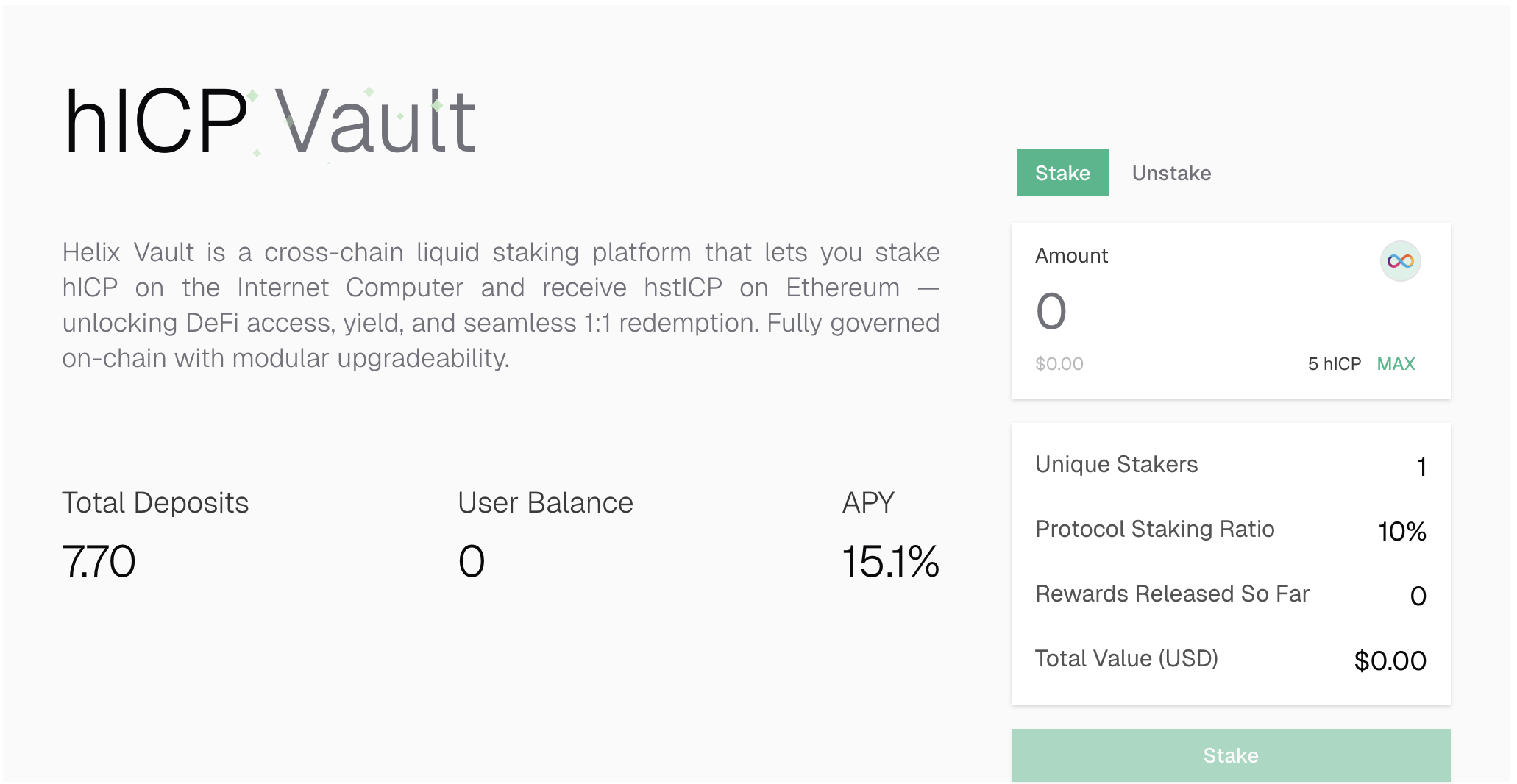
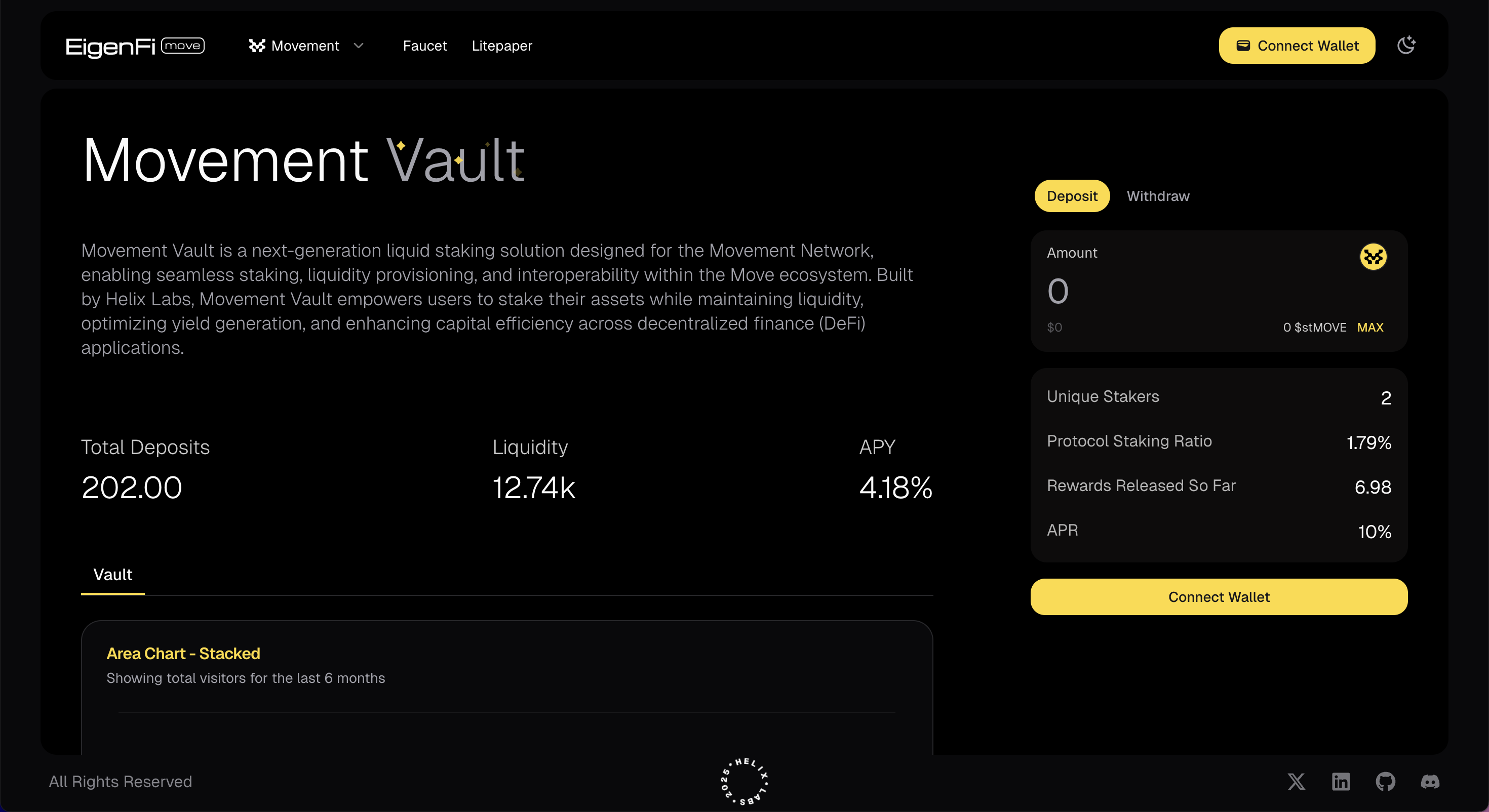
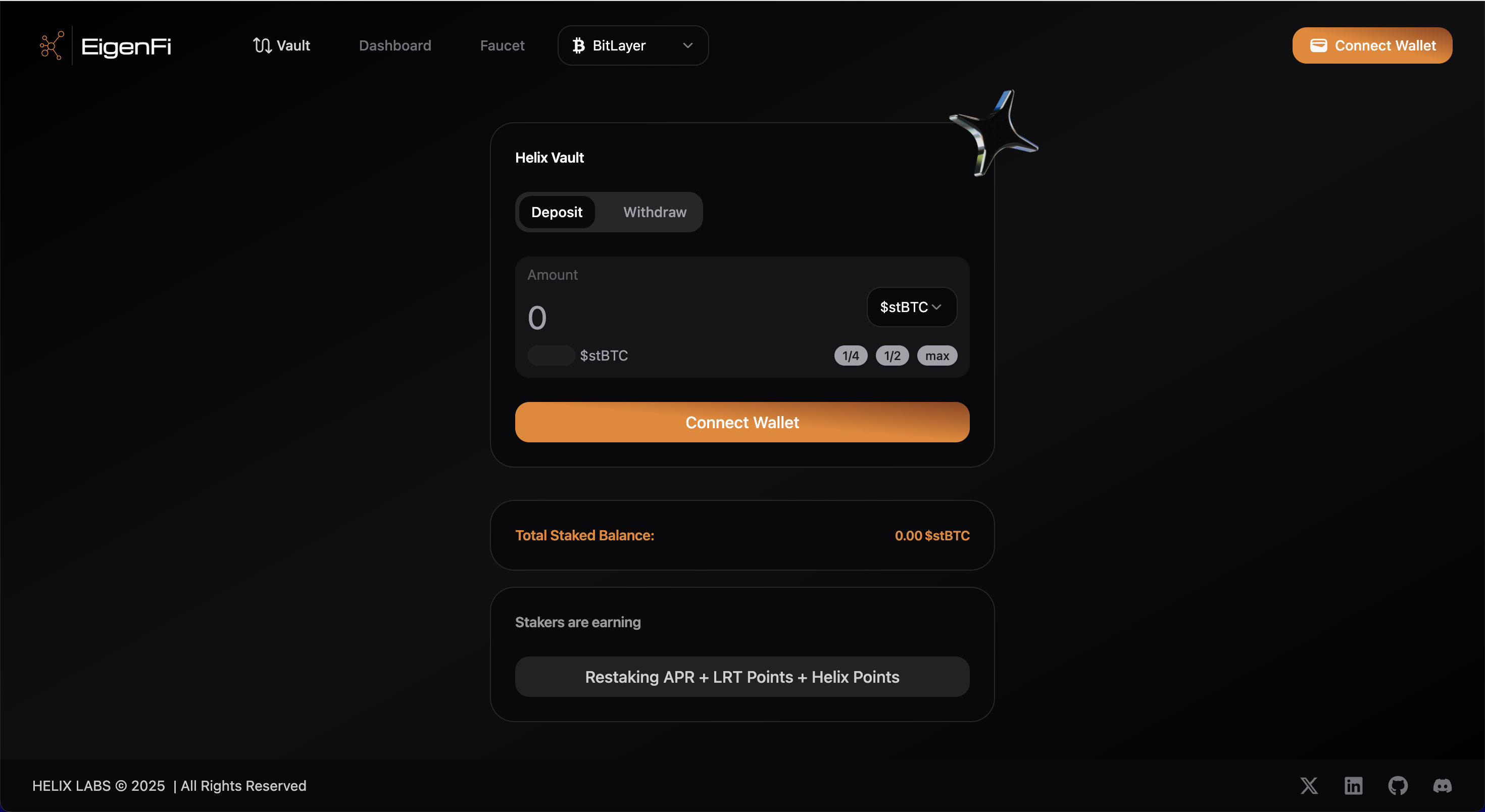
**Helix Vault** — Native liquid staking vaults across multiple L1 blockchains, issuing LSTs that maintain full governance rights and staking rewards on origin chains.

**Helix Terminal** — Unified multi-chain liquidity command center for tracking positions, managing collateral across lending protocols, and optimizing yield.

**Canton Network CDP Protocol** — Collateralized debt positions using multi-chain LSTs as collateral, settling on Canton's institutional DeFi infrastructure.

**Stellar Network Integration** — Cross-chain LST lending that brings external liquidity into Stellar's DeFi ecosystem via Axelar/Chainlink CCIP bridges.

***

### Core Infrastructure

**Native Validator Operations** — We run sovereign validators on each supported blockchain, providing direct control of underlying assets and eliminating bridge security vulnerabilities.

**Canton Network Integration** — Purpose-built for institutional settlement, our CDP protocol enables foundations and validators to finance operations while maintaining staking positions and governance participation.

**Stellar Network Integration** — Cross-chain collateralized lending that channels external L1 liquidity into Stellar's institutional lending markets (Blend, Aquarius) and RWA protocols.

**Chain Fusion Security** — Leveraging ICP's trust-minimized cross-chain verification technology to provide cryptographic proof of reserves across heterogeneous blockchain architectures.

Helix Labs is backed by Tribe Capital, EMURGO Ventures, Taureon Capital, and LD Capital. Canton Network validator operator. DFINITY Foundation developer grant recipient.


# Key Terms

**Canton Network** – A privacy-enabled, permissioned blockchain network designed for institutional finance, enabling compliant DeFi settlement with sub-transaction privacy and regulatory alignment.

**Chain Fusion** – ICP's trust-minimized cross-chain verification technology that enables decentralized, bidirectional communication between multiple blockchains without traditional bridge dependencies or wrapped token security risks.

**Institutional DeFi** – Decentralized finance infrastructure built for regulated financial institutions, incorporating compliance requirements, privacy guarantees, and permissioned architecture.

**L1 (Layer 1)** – Base blockchain networks such as Ethereum, Cardano, ICP, Aptos, Sui, and Solana, which provide foundational security and consensus mechanisms.

**LST (Liquid Staking Token)** – A tokenized representation of staked assets that enables liquidity while continuing to earn native staking rewards, allowing holders to use their staked position in DeFi protocols.

**Native Validator** – Blockchain infrastructure operated directly on a Layer 1 network, providing validator services without intermediary bridges or custodians, enabling direct control of underlying staked assets.

**Trust-Minimized Verification** – Cryptographic proof systems that enable cross-chain asset verification without relying on centralized bridges, multisig custodians, or trusted third parties.


# Problem & Solution: Liquidity vs. Governance Trade-off

**Helix Labs enables strategic token holders—foundations, validators, and institutional stakers—to access liquidity from staked positions without unwinding governance participation or triggering sell pressure on native chains.**\
Blockchain foundations and large validators face a critical constraint: billions in staked assets generate network security and governance rights, but accessing liquidity requires unstaking—which means:

* **Weeks of lockup periods** (7-21 days depending on chain)
* **Lost staking yields** during unstaking
* **Governance exit** and voting power reduction
* **Downward price pressure** on native tokens

Traditional custody solutions cannot access staking yields across multiple chains while maintaining regulatory compliance.

### The Solution: Canton Network CDP Protocol

Helix operates **collateralized debt positions (CDPs)** on Canton Network's institutional settlement layer, enabling users to:

1. **Deposit multi-chain LSTs as collateral** (stETH, stADA, stICP, stATOM, stSOL)
2. **Borrow against staked positions** without unstaking
3. **Preserve native staking yields** (3-8% APY continues accruing)
4. **Maintain governance rights** on origin chains
5. **Access institutional lending markets** (LendOS, Canton lending protocols)

**Key Advantage:** Settlement on Canton Network provides privacy-enabled, compliant infrastructure trusted by Goldman Sachs, BNP Paribas, Circle, and HSBC.

***

### How It Works

#### **Step 1: Native Validator Operations**

Helix runs sovereign validators across seven blockchain networks:

* Cardano
* Internet Computer (ICP)
* BNB Chain
* Aptos
* Sui
* Solana
* Ethereum

Users stake assets through Helix validators and receive **Helix Liquid Staking Tokens (hstTokens)**—e.g., hstADA, hstICP, hstETH.

#### **Step 2: Cross-Chain Verification via ICP Chain Fusion**

Helix uses **ICP's Chain Fusion technology** (threshold cryptography + HTTPS outcalls) to provide cryptographic proof that each hstToken on Canton is backed 1:1 by staked assets on its native chain.

**No bridges. No wrapped tokens. No counterparty risk.**

#### **Step 3: Canton CDP Protocol**

Users bring hstTokens onto Canton Network and:

* Lock collateral in Helix CDP smart contracts (Daml)
* Borrow stablecoins (USDC, USYC) or access credit lines
* Deploy borrowed capital across Canton's institutional DeFi ecosystem (lending, repo markets, RWAs)

**Privacy guarantees:** Canton's sub-transaction privacy model ensures portfolio composition remains confidential—only authorized parties see collateral holdings.

#### **Step 4: Dual Yield Generation**

* **Base Layer:** Continue earning native staking yields on origin chains (3-8% APY)
* **Canton Layer:** Earn yields from institutional lending markets (12-18% on Blend protocol)

**Example:** Cardano Foundation stakes 100M ADA via Helix → receives hstADA → collateralizes on Canton → borrows $2M USDC → deploys into LendOS institutional lending → earns dual yield while maintaining ADA governance participation.

***


# The Helix Ecosystem

#### **Helix Vault**

Native liquid staking vaults across multiple L1 blockchains, issuing LSTs that maintain full governance rights and staking rewards on origin chains.

#### **Canton CDP Protocol**

Collateralized debt positions using multi-chain LSTs as collateral, settling on Canton's institutional DeFi infrastructure.

#### **Stellar Network Integration**

Cross-chain LST lending that brings external L1 liquidity into Stellar's DeFi ecosystem via Axelar/Chainlink CCIP bridges.

#### **Helix Terminal**

Unified multi-chain liquidity command center for tracking positions, managing collateral across lending protocols, and optimizing yield.

***


# Core Infrastructure

**Native Validator Operations**\
We run sovereign validators on each supported blockchain, providing direct control of underlying assets and eliminating bridge security vulnerabilities.

**Canton Network Integration**\
Purpose-built for institutional settlement, our CDP protocol enables foundations and validators to finance operations while maintaining staking positions and governance participation.

**ICP Chain Fusion Security**\
Leveraging Internet Computer's trust-minimized cross-chain verification technology to provide cryptographic proof of reserves across heterogeneous blockchain architectures.

**Stellar Network Integration**\
Cross-chain collateralized lending that channels external L1 liquidity into Stellar's institutional lending markets (Blend, Aquarius) and RWA protocols.

***


# Helix CDP Architecture (High-Level)

<figure><img src="https://2015085276-files.gitbook.io/~/files/v0/b/gitbook-x-prod.appspot.com/o/spaces%2Fy7TO42dKe59i49NeAqm3%2Fuploads%2Flbn4V57I8wQlBdJ5U4iw%2FScreenshot%202026-01-28%20at%2013.40.59.png?alt=media&amp;token=aad38ace-2337-434d-8460-46cb4fee2c7b" alt=""><figcaption></figcaption></figure>

<figure><img src="https://2015085276-files.gitbook.io/~/files/v0/b/gitbook-x-prod.appspot.com/o/spaces%2Fy7TO42dKe59i49NeAqm3%2Fuploads%2F7YMwdNfY5ZBrWKn9mLKw%2FScreenshot%202026-01-28%20at%2015.48.32.png?alt=media&amp;token=787692cb-e7b9-4464-8090-6ec8d5ddb2b0" alt=""><figcaption></figcaption></figure>


# User Flow

## Cardano Fndn Use Case

STEP 1: Stake ADA via Helix Validator 100M ADA → Helix Cardano Validator → Receive 100M hstADA ✓ Earning 5% staking yield ✓ Maintain governance voting rights

STEP 2: Transfer hstADA to Canton via ICP Chain Fusion 100M hstADA → Chain Fusion Proof → 100M hstADA on Canton ✓ Cryptographic verification (no bridge risk)

STEP 3: Lock Collateral in Helix CDP Lock 100M hstADA (worth $50M at $0.50/ADA) Collateralization ratio: 200% → Borrow $25M USDC

STEP 4: Deploy Borrowed Capital $25M USDC → Canton institutional lending (LendOS) → Earn 15% APY on lent capital

```
DUAL YIELD OUTCOME:
Base: 5% on 100M ADA = $2.5M/year
Canton: 15% on $25M USDC = $3.75M/year
Total: $6.25M/year revenue
Foundation maintains: ADA governance participation + staking position
```


# What is hstXDC

Section 1 (sec1)

* > **One-line:** A liquid staking primitive that lets institutional XDC holders deposit XDC into a regulated, transparent vault that mints `hstXDC` on Canton Network — preserving XDC native staking yield, governance rights, and validator selection while unlocking the position for institutional credit and yield strategies on Canton.

### The Thesis

hstXDC sits at the convergence of two regulated-counterparty L1s:

* **XDC Network** — 108 KYC-verified validator masternodes, BFT deterministic finality (\~6 seconds), full EVM compatibility since the v2.6.8 Cancun upgrade (mainnet block 98,800,200, January 2026), Subnet capability for permissioned execution environments.
* **Canton Network** — Privacy-preserving institutional settlement layer with native sub-transaction privacy, the CIP-56 token standard for interoperable institutional assets, and a production track record carrying real-world financial settlement at institutional scale.

The opportunity these two chains create together is structurally unusual: **two L1s where the validator set is identifiable, the settlement guarantees are deterministic, and the user can map the trust assumptions onto regulated counterparty frameworks.** Most cross-chain liquid staking products bridge a permissionless L1 to a permissionless DeFi venue. hstXDC bridges a KYC'd L1 to an institutional settlement network. The trust assumptions on both sides match the user's existing mental models.

<figure><img src="https://2015085276-files.gitbook.io/~/files/v0/b/gitbook-x-prod.appspot.com/o/spaces%2Fy7TO42dKe59i49NeAqm3%2Fuploads%2FQobZEUIB0PLQYwxcFwjS%2FScreenshot%202026-04-09%20at%2016.39.21.png?alt=media&amp;token=9d72236c-4272-4020-aa59-c956b32d99fb" alt=""><figcaption></figcaption></figure>

### What hstXDC does, mechanically

<table><thead><tr><th width="103.625">Layer</th><th>What happens</th></tr></thead><tbody><tr><td><strong>Deposit</strong></td><td>Institutional holder deposits XDC into the Helix Vault contract on XDC mainnet. XDC enters the masternode delegation flow and accrues native staking yield.</td></tr><tr><td><strong>Mint</strong></td><td>Bridge layer signals the deposit to the Canton-side vault contract, which mints <code>hstXDC</code> 1:1 to the holder's Canton party. <code>hstXDC</code> is a CIP-56 compliant token.</td></tr><tr><td><strong>Hold</strong></td><td>The holder retains: XDC native staking yield (the LST appreciates against XDC over time), XDC governance rights via the validator selection layer, and full programmability of <code>hstXDC</code> on Canton — DvP, repo, lending, qualified custody.</td></tr><tr><td><strong>Redeem</strong></td><td>Holder burns <code>hstXDC</code> on Canton; bridge layer signals the burn to XDC mainnet; XDC is unstaked through the standard XDC validator unbonding flow and returned to the holder.</td></tr></tbody></table>

### What hstXDC is not

* **Not a wrapped token.** `hstXDC` is not a 1:1 wrapper of XDC on a different chain. It is a liquid staking token: it represents a *staked* XDC position, and its exchange rate against XDC drifts upward over time as native yield accrues to the underlying.
* **Not a cross-chain asset.** XDC stays on XDC. `hstXDC` lives on Canton. There is no XDC token crossing the bridge layer — only attestations of stake state. This is the load-bearing security choice (see sec5).
* **Not custodial.** Helix does not hold customer XDC in a Helix-controlled wallet. The vault contract holds delegations on-chain with constrained admin keys, and the bridge layer is protected by a threshold-signature attestor design pattern (see sec5, sec8).
* **Not yet live.** hstXDC is in the architecture and scoping phase as of April 2026. Helix's Canton-side infrastructure is already in production (see sec10); the hstXDC vault is in design. Honest status disclosure is in sec2 — no claims of shipped functionality before there is shipped functionality.

### Why this matters for institutional users

The full institutional thesis lives in sec6 and sec7. The three-sentence version:

1. A holder of locked institutional Canton-side positions and a holder of staked XDC can now operate both positions through a single Canton-side surface, without the value-bearing assets ever crossing a bridge committee.
2. The bridge layer carries authorization signals only — not the assets themselves — which collapses the institutional custody question to *"who custodies the XDC on XDC, and who custodies the LST on Canton."*
3. BitGo qualified custody covers both ends as of March 25 2026. The custody question is already answered.


# Status

Section 2 (sec2)

> **Where hstXDC is right now (April 2026):** in architecture and scoping. The Canton-side infrastructure that hstXDC depends on is already in production; the hstXDC-specific vault and bridge layer are in design. This section is the honest disclosure -- what exists, what doesn't, what we're building toward, and what user expectations should be calibrated to.

### What's live today

| Component                                                        | Status                     | Where to verify                                                                                                                         |
| ---------------------------------------------------------------- | -------------------------- | --------------------------------------------------------------------------------------------------------------------------------------- |
| **Helix Canton SV compliance dashboard**                         | LIVE                       | [vault.helixlabs.org/sv-locking](https://vault.helixlabs.org/sv-locking) -- public, ungated, CIP-0105 SV compliance observation surface |
| **Canton-side observation-first vault architecture**             | PRODUCTION (deployed)      | Active package `helix-v2g` on the Canton mainnet path; see sec10 for credibility anchors                                                |
| **CIP-56 token standard on Canton**                              | PRODUCTION ecosystem-wide  | Used by cBTC and USDCx, the two production Canton↔external bridges; see sec5 for prior-art context                                      |
| **Native USDC + Circle CCTP V2 on XDC**                          | LIVE since September 2025  | xdc.org primary source; see sec7                                                                                                        |
| **BitGo qualified custody — XDC mainnet (XDC + USDC)**           | LIVE since February 1 2026 | $250M insurance, MPC custody, BitGo Bank & Trust                                                                                        |
| **BitGo qualified custody — Canton CIP-56 assets (cBTC, USDCx)** | LIVE since March 25 2026   | The same regulated entity custodies both ends; see sec6                                                                                 |

The institutional plumbing hstXDC depends on is **already there**. We are not waiting on Circle, BitGo, the Canton CIP-56 standard, the XDC EIP-1559 / Cancun upgrade, or qualified-custody coverage. None of those are gates.

### What's in design

| Component                                       | Status | Notes                                                                                                                                                           |
| ----------------------------------------------- | ------ | --------------------------------------------------------------------------------------------------------------------------------------------------------------- |
| **hstXDC vault contracts (Canton side)**        | DESIGN | Daml templates specified; contract authorization model worked through; awaiting implementation. See sec4.                                                       |
| **XDC-side staking integration**                | DESIGN | Masternode delegation flow scoped against XDC's standard validator unbonding lifecycle.                                                                         |
| **Cross-chain bridge layer (attestor network)** | DESIGN | Architecture choice resolved (hybrid issuer-attested + threshold-signature attestor net); attestor set composition and signing thresholds in scoping. See sec5. |
| **Recursive staking loop (v1.1)**               | DESIGN | Loop closure depends on USDC-denominated lending markets on XDC reaching adequate depth. v1 ships without the loop. See sec4.                                   |

### What is explicitly out of scope (today)

* A general-purpose Canton ↔ XDC smart-contract messaging bridge. hstXDC's bridge layer is purpose-built for stake-state attestation, not general state transport. A general bridge is a possible future expansion, not a v1 commitment.
* A Helix-issued stablecoin on either chain. We use Circle's native USDC + CCTP V2 throughout. We are not in the stablecoin issuance business.
* Custody of customer XDC in a Helix wallet. The vault contract holds the delegation directly on XDC mainnet with constrained admin keys; custody is via BitGo or the holder's preferred qualified custodian, not Helix.
* Wrapped XDC on Canton. `hstXDC` is a *liquid staking token*, not a wrapper. There is no `xXDC` or `wXDC` in the architecture.

### Build phases

The hstXDC build is structured in phases. Each phase has a hard gate before the next begins.

| Phase                                            | Scope                                                                                                                          | Gate to next phase                                                |
| ------------------------------------------------ | ------------------------------------------------------------------------------------------------------------------------------ | ----------------------------------------------------------------- |
| **Phase 0 — Architecture & scoping** *(current)* | Daml templates specified, bridge layer architecture chosen, security model designed, partner alignment with the XDC Foundation | Architecture document accepted; engineering resources allocated   |
| **Phase 1 — Vault contracts on Canton**          | hstXDC Daml templates implemented, tested in Canton DevNet, exercised through standard mint/burn flows                         | Internal contract review + external review                        |
| **Phase 2 — XDC-side integration**               | Vault contract on XDC mainnet, masternode delegation lifecycle wired through, deposit/withdraw exercised on XDC testnet        | XDC testnet deposit-mint-redeem cycle proven end-to-end           |
| **Phase 3 — Bridge layer activation**            | Threshold-signature attestor set deployed, end-to-end mint and burn proven across the bridge layer on testnet                  | Attestor set composition finalized, security review completed     |
| **Phase 4 — Mainnet readiness**                  | Mainnet deployment, qualified custody integration, institutional onboarding flow                                               | Audit completion, mainnet smoke test, first institutional deposit |

We do not give public dates for phase transitions in this document. Build pace is communicated to active partners directly. If you are evaluating hstXDC for a specific timeline, contact us — see sec10.

### Honest read for the institutional user

1. **The dependencies are mature.** Every external system hstXDC needs is already in production. We are not betting on a future Circle launch, a future BitGo expansion, a future Canton standard, or a future XDC upgrade.
2. **The Helix Canton track is live and observable.** You can verify our Canton execution capacity at vault.helixlabs.org/sv-locking today. hstXDC is not Helix's first piece of Canton infrastructure.
3. **The hstXDC vault itself is not yet built.** This is a scoping-phase document. If you need a live mainnet hstXDC contract address, that does not exist yet. If you need an architecture you can review, audit, and commit to before contracts are written — that is exactly what these docs are for.
4. **The build sequence has hard gates, not soft milestones.** We do not move to the next phase before the previous phase clears its gate. You can ask us about gate criteria specifically; we will answer specifically.


# XDC Network Fit

Section 3 (sec3)

> hstXDC requires an L1 with three properties simultaneously: an identifiable validator set users can map to counterparty risk, deterministic settlement finality compatible with cross-chain attestation, and a mature execution + custody surface ready for institutional capital today. XDC is one of a small handful of L1s where all three are present in the same chain.

### Validator topology

<table><thead><tr><th width="173.75390625">Property</th><th width="214.828125">XDC</th><th>Why it matters for hstXDC</th></tr></thead><tbody><tr><td>Active validator set</td><td><strong>108 masternodes</strong></td><td>Small enough to enumerate, large enough to distribute. Users can map the validator set to a known list rather than an anonymous PoS pool.</td></tr><tr><td>KYC requirement</td><td><strong>All 108 validators KYC-verified</strong></td><td>The single most differentiated property of XDC among EVM L1s. Bridge attestor sets co-located with XDC validators can be jurisdictionally diversified by design — the Multichain failure mode (jurisdictional concentration of key holders) is structurally avoided.</td></tr><tr><td>Stake threshold</td><td><strong>10,000,000 XDC per masternode</strong>, no upper bound</td><td>High enough to constitute a meaningful economic commitment per validator slot.</td></tr><tr><td>Slashing model</td><td><strong>Two-tier</strong>: equivocation triggers stake burn; underperformance triggers exclusion without token loss</td><td>Distinguishes attack from operational failure — important for institutional validator operators who can absorb downtime risk but not slash risk.</td></tr><tr><td>Forensic monitoring</td><td><strong>On-chain accountability layer (XDC 2.0)</strong> that produces irrefutable evidence of misbehavior, routed to governance</td><td>Auditability surface for the bridge attestor set and the underlying staking layer.</td></tr></tbody></table>

**Source:** \[\[xdc-network-fundamentals]] sec1, sec2 — primary citations from the XDC Foundation technical specification and the Shi et al. consensus paper (arXiv:2108.01420).

### Settlement finality and execution

| Property            | XDC                                                                             | Why it matters for hstXDC                                                                                                                      |
| ------------------- | ------------------------------------------------------------------------------- | ---------------------------------------------------------------------------------------------------------------------------------------------- |
| Consensus mechanism | **XDPoS 2.0 — HotStuff BFT overlay on Delegated PoS**                           | Deterministic finality, not probabilistic. Confirmed blocks cannot fork or roll back as long as fewer than 1/3 of masternodes are adversarial. |
| Block time          | **\~2 seconds**                                                                 | Fast enough for live institutional UX without optimizing for HFT.                                                                              |
| Finality time       | **\~6 seconds** (3 Block-Aggregation-Times after inclusion)                     | Bridge attestation can be authorized after a single finality round. No multi-confirmation wait windows.                                        |
| EVM compatibility   | **Full Cancun parity** since v2.6.8 (mainnet block 98,800,200, January 15 2026) | The hstXDC vault contract on the XDC side can use modern Solidity patterns. Tooling parity with the Ethereum ecosystem.                        |
| Fee model           | **EIP-1559 base-fee burn + priority fee**, live post-Cancun                     | Predictable fee dynamics under load. The bridge attestor flows have bounded fee exposure.                                                      |
| Native gas token    | XDC                                                                             | The same asset users are staking is the asset that pays for transactions — clean economic loop.                                                |

### Subnet capability

XDC's Subnet architecture (shipped September 2024 with XDC 2.0) provides a permissioned execution layer anchored to XDC mainnet via header attestation. Subnets are operated by their own permissioned masternode set, periodically commit headers to the mainnet, and inherit auditability from the mainnet anchor.

**Why this matters for hstXDC:**

* The bridge layer (see sec5) can optionally run inside an XDC permissioned subnet operated by KYC'd institutional counterparties.
* The mainnet anchoring provides public auditability for regulated users without requiring the bridge state machine to compete with general mainnet congestion.
* This is a fallback architecture, not a primary one — the hybrid attestor-network design described in sec5 is the primary recommendation. The Subnet path exists as a complementary deployment option for partners who prefer execution isolation.

**Source:** \[\[xdc-network-fundamentals]] sec5; \[\[xdc-bridge-architectures]] secA.6 (XDC Zero) for the related cross-chain infrastructure context.

### Native stablecoin and custody readiness

This is the property that turned XDC from "credible L1" into "credible L1 ready for institutional capital deployment today." Two events in the last twelve months made the difference:

| Event                                                        | Date            | What it unlocked                                                                                                                                                                 |
| ------------------------------------------------------------ | --------------- | -------------------------------------------------------------------------------------------------------------------------------------------------------------------------------- |
| **Native USDC + Circle CCTP V2 live on XDC mainnet**         | September 2025  | XDC is a Circle-supported chain. USDC is native, not bridged — Circle is the trust root, no third-party bridge committee. Burn-and-mint transfers across all 24+ CCTP V2 chains. |
| **BitGo Bank & Trust qualified custody — XDC + USDC on XDC** | February 1 2026 | Federally chartered US qualified custody. MPC architecture. $250M insurance coverage. The first qualified custody coverage for XDC mainnet by a federally chartered US entity.   |

The institutional capital path *into* XDC no longer depends on a future infrastructure unlock. Both the asset-side (native USDC) and the custody-side (BitGo) exist today.

**Source:** \[\[xdc-stablecoin-state]] secUSDC on XDC, secCustody partners.

### What XDC is not (the honest counter-framing)

For balance, the properties XDC is **not** strong on, that the hstXDC architecture has to either work around or accept:

* **DEX liquidity depth on XDC mainnet is small.** Largest single-DEX pools sit in the high-five-figure to low-six-figure dollar range. Institutional execution at $1M+ size requires routing via deeper-liquidity chains and CCTP V2 settle-back, not single-DEX trades. See sec7 for the routing strategy. The hstXDC product surface is largely insulated from this — the lending loop does not depend on deep on-chain spot liquidity.
* **DeFi TVL (DefiLlama-tracked) is modest** — low tens of millions as of early 2026. XDC's growth thesis is RWA tokenization and institutional flows, not retail DeFi gravity. hstXDC is aligned with the institutional thesis, not the DeFi-TVL race.
* **No production Canton↔external bridge currently exists** in the specific shape hstXDC needs. cBTC and USDCx are production Canton↔external bridges, but neither is a Canton↔EVM smart-contract-platform bridge. The bridge layer (see sec5) is the part of hstXDC that is novel — and the part that requires the most careful security framing.

**The fit verdict**: XDC matches hstXDC's requirements on validator topology, finality, execution maturity, and institutional readiness. The chain's weak surfaces (retail DeFi liquidity, general bridge ecosystem maturity) are either irrelevant to the product or are surfaces hstXDC is itself designed to fill.


# Architecture

Section 4 (sec4)

> hstXDC is two vault contracts (one on Canton, one on XDC) connected by an attestation-only bridge layer. This section walks each piece in mechanical detail: contract surface, party structure, admin authority, state transitions, and where the security perimeter actually sits.

### Component map

<table><thead><tr><th width="149.265625">Component</th><th width="184.19140625">Chain</th><th width="131.8671875">Language</th><th>Role</th></tr></thead><tbody><tr><td><strong>Helix Vault -- Canton side</strong></td><td>Canton (dedicated synchronizer)</td><td>Daml</td><td>Mints <code>hstXDC</code> against bridge-attested deposits; burns <code>hstXDC</code> on user redemption and emits unlock attestations; tracks the per-user staked balance and the global exchange rate</td></tr><tr><td><strong>Helix Vault -- XDC side</strong></td><td>XDC mainnet</td><td>Solidity</td><td>Receives XDC deposits; delegates them through the standard XDC masternode delegation lifecycle; emits deposit and unstake events that the bridge layer attests to</td></tr><tr><td><strong>Bridge attestor layer</strong></td><td>Off-chain (FROST/TSS network) + on-chain witness contracts on both sides</td><td>Rust / Solidity / Daml</td><td>Watches both vaults; produces threshold-signed attestations of state transitions; submits attestations to the opposite-side vault to authorize mint or unlock</td></tr><tr><td><strong><code>hstXDC</code> token</strong></td><td>Canton</td><td>Daml (CIP-56 compliant)</td><td>Liquid staking token. Non-rebasing, share-based. Exchange rate against XDC drifts upward as native staking yield accrues.</td></tr></tbody></table>

The hstXDC architecture has **no off-chain custody process**. The XDC sits in the on-chain vault contract on XDC mainnet at all times. The Canton-side vault holds Daml state, not custody of XDC. The bridge layer holds threshold signature shares, not assets.

### Canton-side vault

The Canton-side vault is a Daml workflow built around three template families:

#### Template family 1 -- `HelixVaultConfig`

Singleton contract that holds the vault's global parameters. Authored by the Helix operator party. Read by every other vault contract.

<table><thead><tr><th width="256.87890625">Field</th><th>Purpose</th></tr></thead><tbody><tr><td><code>operator</code></td><td>The Helix operator party -- has authority to update vault parameters, never authority over user balances</td></tr><tr><td><code>bridgeAttestorParty</code></td><td>The Canton-side party representing the threshold-signed attestor set. The only party authorized to issue mint authorizations.</td></tr><tr><td><code>exchangeRate</code></td><td>Global accumulator. Updates as XDC native staking yield is reported by the bridge layer. Monotonically non-decreasing.</td></tr><tr><td><code>pausedFlag</code></td><td>Operator-controlled circuit breaker. When set, blocks new mints but never blocks redemptions.</td></tr></tbody></table>

#### Template family 2 -- `UserPosition`

Per-user contract recording the holder's `hstXDC` balance and entitlement. Authored jointly by the holder party and the operator party (multi-party authorization).

| Choice     | Authorization                  | Effect                                                                                                       |
| ---------- | ------------------------------ | ------------------------------------------------------------------------------------------------------------ |
| `Mint`     | bridgeAttestorParty + operator | Creates `hstXDC` to the holder party against an attested deposit                                             |
| `Burn`     | holder                         | Holder-initiated. Marks the position for redemption. Burns the `hstXDC` and emits a Canton-side burn record. |
| `Transfer` | holder                         | Standard CIP-56 transfer. Transfers `hstXDC` to another Canton party.                                        |

The critical authorization rule: **the operator cannot mint on its own.** Mint requires the `bridgeAttestorParty` co-signature, which only exists when the threshold-signed attestor set has produced a valid attestation. The operator's authority is limited to vault configuration, not to creating or moving holder assets.

#### Template family 3 -- `RedemptionRequest`

Per-redemption contract that captures a holder's intent to unstake. Authored by the holder party; consumed by the bridge attestor party once the XDC-side unstake completes.

| Field            | Purpose                                                    |
| ---------------- | ---------------------------------------------------------- |
| `holder`         | The redeeming party                                        |
| `amount`         | hstXDC amount being redeemed                               |
| `xdcDestination` | The XDC mainnet address that will receive the unstaked XDC |
| `requestedAt`    | Canton-side timestamp; used to anchor the unbonding clock  |

The redemption flow is asynchronous by design -- XDC's masternode unbonding lifecycle introduces a chain-native delay that the Canton vault cannot shortcut. The `RedemptionRequest` contract represents the redemption commitment during that window.

### XDC-side vault

The XDC-side vault is a Solidity contract deployed on XDC mainnet, structured around three responsibilities:

#### Responsibility 1 -- Deposit and delegation

Holders deposit XDC by calling `deposit()`. The contract:

1. Records the deposit in per-holder accounting
2. Routes the deposited XDC into a delegation to a Helix-operated masternode (or a configured masternode set; see admin model below)
3. Emits a `Deposited(holder, amount, blockNumber)` event that the bridge attestor layer watches

The contract does not mint anything on the XDC side. There is no `xXDC` or `wXDC`. The deposit event is the entire output -- the corresponding `hstXDC` mint happens on Canton, against the attestation of this event.

#### Responsibility 2 -- Yield accrual reporting

The contract exposes a `currentExchangeRate()` view function that returns the current XDC-denominated value of one share of the vault's staked position. As the underlying delegation accrues native staking yield, this rate increases.

The bridge attestor layer periodically reads this view function, produces a threshold-signed attestation of the new rate, and submits it to the Canton-side vault to update the global `exchangeRate`. **The exchange rate is monotonically non-decreasing on both sides.** No rebasing, no negative rate adjustments. Slashing (which on XDC affects only the masternode operator's stake, not delegated stakes) does not propagate to holder positions.

#### Responsibility 3 -- Unstake and redemption

When a holder requests redemption on the Canton side, the bridge attestor layer submits an attestation to the XDC contract authorizing an unstake. The XDC contract:

1. Initiates an unstake of the appropriate proportion of the delegated position
2. Waits the standard XDC masternode unbonding window
3. Returns the unstaked XDC to the holder's specified XDC mainnet address
4. Emits an `Unstaked(holder, amount, blockNumber)` event that the bridge layer attests to, allowing the Canton-side `RedemptionRequest` to be consumed and the corresponding `hstXDC` to be permanently burned

The unbonding window is a property of XDC's consensus, not of hstXDC. Holders should expect the redemption flow to take the full XDC unbonding period. This is consistent with all native PoS staking on the chain.

### Admin key model

The admin key model is the part of the architecture institutional users will scrutinize first. The design intent is to **minimize the powers any single key holder has**, and to ensure that **no admin operation can move user assets**.

| Admin role                     | Who holds it                                                                                                                 | What it can do                                                                                                                                           | What it CANNOT do                                                                                                                                                                                                          |
| ------------------------------ | ---------------------------------------------------------------------------------------------------------------------------- | -------------------------------------------------------------------------------------------------------------------------------------------------------- | -------------------------------------------------------------------------------------------------------------------------------------------------------------------------------------------------------------------------- |
| **Vault operator (multi-sig)** | Helix operator multi-sig (target: 3-of-5 across geographically distributed key holders)                                      | Update vault parameters (paused flag, masternode selection, fee parameters); pause new deposits                                                          | **Cannot mint hstXDC**. Cannot move holder assets. Cannot bypass the bridge attestor layer. Cannot accelerate unbonding. Cannot redirect redemptions.                                                                      |
| **Bridge attestor set**        | Threshold-signature attestor network (target: distributed across institutional operators including but not limited to Helix) | Produce attestations of state transitions on both vaults; authorize mints on Canton against XDC deposits; authorize unstakes on XDC against Canton burns | **Cannot mint without an underlying XDC deposit.** Cannot mint to an address that didn't deposit. Cannot redirect deposits. Cannot pause the vault.                                                                        |
| **Holder**                     | Individual depositor                                                                                                         | Deposit XDC; transfer hstXDC; initiate redemption                                                                                                        | Cannot mint hstXDC outside the deposit flow. Cannot bypass the unbonding period.                                                                                                                                           |
| **Upgrade authority**          | TBD -- under design                                                                                                          | Future contract upgrades on either side                                                                                                                  | The current intent is to make the vault contracts non-upgradable on the XDC side and use Daml package migration on the Canton side. Upgrade authority itself is under active scoping and will be specified before mainnet. |

**The two load-bearing rules:**

1. **No single key can mint hstXDC.** Mint authorization requires the threshold-signed attestor set to produce an attestation. The operator multi-sig is a separate role and cannot substitute for the attestor set.
2. **No admin role can move user assets.** Admin powers are limited to parameter updates and circuit-breaker controls. Moving holder XDC, holder hstXDC, or the underlying delegation requires the standard user-initiated flows (deposit, redeem, transfer) -- not an admin operation.

These two rules are the security perimeter. Everything else in the admin model is parameter management.

### State transitions, end to end

The full lifecycle of a hstXDC position, mapped to which contracts authorize each step:

| Step                                    | Initiator             | XDC-side contract                                                        | Bridge attestor                                                                 | Canton-side contract                                                                            |
| --------------------------------------- | --------------------- | ------------------------------------------------------------------------ | ------------------------------------------------------------------------------- | ----------------------------------------------------------------------------------------------- |
| 1. User deposits XDC                    | Holder                | `deposit()` records deposit, routes to delegation, emits `Deposited`     | Watches `Deposited` event; produces threshold-signed attestation of the deposit | -                                                                                               |
| 2. Mint authorization arrives on Canton | Bridge attestor layer | -                                                                        | Submits attestation to Canton vault                                             | Attestation received; `Mint` choice exercised on `UserPosition` template                        |
| 3. hstXDC minted to holder              | -                     | -                                                                        | -                                                                               | `UserPosition` contract created with holder's balance; `hstXDC` token in holder's Canton wallet |
| 4. Yield accrues                        | XDC consensus         | Delegation earns native staking yield; `currentExchangeRate()` increases | Periodically reads rate, attests, submits to Canton                             | `HelixVaultConfig.exchangeRate` updated; holder's hstXDC appreciates against XDC                |
| 5. Holder initiates redemption          | Holder                | -                                                                        | -                                                                               | `Burn` choice exercised; `RedemptionRequest` contract created                                   |
| 6. Unstake authorization arrives on XDC | Bridge attestor layer | -                                                                        | Submits unstake attestation to XDC vault                                        | -                                                                                               |
| 7. XDC unstake initiated                | XDC vault contract    | Calls XDC unbonding; waits unbonding window                              | -                                                                               | --                                                                                              |
| 8. Unbonding completes                  | XDC consensus         | Unstaked XDC returned to holder address; emits `Unstaked` event          | Watches `Unstaked` event; attests                                               | -                                                                                               |
| 9. Canton-side redemption finalized     | Bridge attestor layer | -                                                                        | Submits unstake-completion attestation to Canton                                | `RedemptionRequest` consumed; `hstXDC` permanently burned                                       |

The full deposit-mint flow (steps 1-3) completes in the time it takes for XDC finality plus one bridge attestation round -- on the order of tens of seconds. The redemption flow (steps 5-9) is bounded by the XDC unbonding window, which is a property of the chain, not of hstXDC.

### v1 versus v1.1 -- what ships when

The hstXDC v1 product is the deposit, mint, hold, and redeem flow described above. **v1 does not include the recursive staking loop.**

The recursive staking loop -- borrow stables against `hstXDC` collateral on Canton, swap stables for XDC, redeposit, repeat -- is the v1.1 expansion. It depends on two conditions that are not yet met:

1. A USDC-denominated lending market on Canton that accepts `hstXDC` as collateral. This depends on Canton-side lending venues activating CIP-56 collateral support -- which is in scope for those venues but not yet shipped at the time of writing.
2. Adequate execution depth for the stable-to-XDC swap leg. The current XDC mainnet DEX depth (see sec7) is insufficient for institutional-size loops; the loop becomes practical when execution can route through CCTP V2 to deeper-liquidity chains and settle back.

Both conditions are external to hstXDC itself. v1 ships independently of them. v1.1 unlocks when the conditions are met.

The architecture in v1 is forward-compatible with v1.1 -- no contract rewrites are required. The loop is composed of standard `hstXDC` transfers and CIP-56 collateral interactions. When the lending venues are ready, the loop is just a workflow, not a new product.


# Cross-Chain Bridge Layer

Section 5 (sec5)

Logged. Reading USER.md to add the preference cleanly.Logged. Both formatting rules now in `_jarvis/USER.md` Working Style section -- the dash rule and the `sec` rule co-located. Drafting sec5 now.

***

> The bridge layer is the part of hstXDC where the wrong architecture choice is the most common cause of catastrophic failure in cross-chain products. Most bridge exploits in the last five years did not lose user funds because of cryptography or smart-contract bugs; they lost user funds because the trust model collapsed to a small committee of signers who could be compromised, coerced, or arrested. This section walks why hstXDC's bridge layer avoids that failure mode by construction.

### The architecture choice

Bridge layer trust models fall into a small number of canonical patterns. The choice between them is not a matter of taste -- each pattern has a specific failure mode, and the institutional reader has to know which failure mode they are signing up for.

| Pattern                                                | How trust collapses                                                                                                                                                                       | Where it has lived in practice                                                                                                                                            |
| ------------------------------------------------------ | ----------------------------------------------------------------------------------------------------------------------------------------------------------------------------------------- | ------------------------------------------------------------------------------------------------------------------------------------------------------------------------- |
| **Notarized witness multisig**                         | Honest-majority committee assumption. Failure when the committee is compromised, coerced, or jurisdictionally concentrated.                                                               | Ronin ($625M), Wormhole ($326M), Nomad ($190M), Multichain ($125M+), Harmony Horizon ($100M). **Where every major bridge exploit since 2021 has lived.**                  |
| **Lock-and-mint vault**                                | Custody of the lock vault. Failure when the vault keys are compromised.                                                                                                                   | Many wrapped-asset designs. Same failure surface as multisig when the vault is held by a small set of keys.                                                               |
| **Issuer-attested burn-and-mint**                      | The asset issuer is the trust root. Failure only on issuer credit risk or attestation infrastructure outage. **No bridge committee, no vault to drain.**                                  | Circle CCTP V2 (USDC across 24+ chains, including XDC since September 2025). USDCx on Canton (Circle xReserve protocol, in production for institutional repo settlement). |
| **Threshold-signature attestor network (FROST / TSS)** | Threshold cryptography over a distributed attestor set. Failure requires compromising the threshold simultaneously across geographically diversified operators. **No single key holder.** | cBTC on Canton (BitSafe, FROST over a distributed attestor network including Kiln and Figment, in production with BitGo qualified custody).                               |
| **Light-client / zk**                                  | The destination chain verifies the source chain's consensus directly. Failure only on cryptographic break or implementation bug in the verifier.                                          | IBC across the Cosmos zone. Polymer / Succinct experimental EVM variants. Structurally hardest to apply to non-EVM destinations.                                          |
| **Subnet anchor (XDC-specific)**                       | Permissioned execution layer anchored to mainnet via header attestation. Failure on the subnet's permissioned validator set.                                                              | XDC Zero, in production for XDC Subnet ↔ XDC mainnet flows since September 2024.                                                                                          |

The four patterns at the bottom -- issuer-attested, FROST attestor network, light-client, and subnet anchor -- are where institutional bridges should live. The two at the top are where retail bridges have repeatedly failed.

**hstXDC's bridge layer uses a hybrid of the two best-fit patterns: issuer-attested for first-party-issued assets like USDC, and FROST attestor network for non-issuer assets like XDC.** Neither half of the hybrid is novel in isolation. Both halves are in production today on Canton, with regulated US qualified custody coverage.

### D3 -- Trust Topology Comparison (visual aid)

**Purpose:** Show the institutional reader, in one image, why the architecture choice matters. Three panels side by side, one labeled as the failure-mode-by-construction pattern, two labeled as the patterns hstXDC uses.

**Layout:** Three roughly equal-sized panels, left to right. Each panel is a small box-and-arrow diagram with a caption underneath.

```
┌──────────────────────┐  ┌──────────────────────┐  ┌──────────────────────┐
│  ❌  AVOID           │  │  ✅  USE FOR         │  │  ✅  USE FOR         │
│  Notarized witness   │  │  ISSUER ASSETS       │  │  NON-ISSUER ASSETS   │
│  multisig            │  │  (e.g. USDC)         │  │  (e.g. XDC)          │
│                      │  │                      │  │                      │
│  Source chain        │  │  Source chain        │  │  Source chain        │
│      ↓               │  │      ↓ burn          │  │      ↓               │
│  ┌────────┐          │  │  ┌────────┐          │  │  ┌────────┐          │
│  │ 5-of-9 │          │  │  │ Issuer │          │  │  │ FROST  │          │
│  │ multi- │          │  │  │ signs  │          │  │  │ /TSS   │          │
│  │ sig    │          │  │  │ (Circle│          │  │  │ attest │          │
│  └────────┘          │  │  └────────┘          │  │  │ -or net│          │
│      ↓               │  │      ↓ attestation   │  │  └────────┘          │
│  Destination chain   │  │  Destination chain   │  │      ↓               │
│                      │  │      ↓ mint          │  │  Destination chain   │
└──────────────────────┘  └──────────────────────┘  └──────────────────────┘
   Caption:                  Caption:                  Caption:
   "Where every major         "No bridge vault.         "Threshold crypto over
    bridge exploit lived:      Trust collapses to        a distributed
    Ronin $625M,               the asset issuer.         attestor set. cBTC
    Wormhole $326M,            CCTP V2 pattern.          on Canton uses this.
    Nomad $190M,               In production on          Production today."
    Multichain $125M+"         XDC since Sept 2025"
```

**Visual punch:** ❌ multisig | ✅ issuer-attested | ✅ FROST attestor net. The right pattern depends on the asset class, and we use the right one for each.

**Color suggestion:** keep the AVOID panel in a muted/grayed tone, the two USE panels in your normal palette. The visual contrast does half the work of the caption.

### Canton-side design constraint -- the authorized observer party

Canton's privacy model adds a constraint that EVM↔EVM bridge designs do not have to think about. On Canton, a transaction can have multiple subtransactions, each visible only to authorized parties. A bridge contract that needs to *prove externally* that a state transition happened cannot rely on a global observer -- the relevant subtransaction may not be visible to anyone outside the parties to the burn.

**The design rule that follows:** the bridge attestor network must be an explicitly authorized observer party on every contract whose state it needs to attest to.

In practice this means:

* The Canton-side `UserPosition` template (see sec4) lists the bridge attestor party as a stakeholder on every burn choice, ensuring the attestor network can observe the burn
* The Canton-side `RedemptionRequest` template includes the attestor party in its signatory set, ensuring the redemption commitment is visible to the attestors who will eventually authorize the unstake on XDC
* The attestor party's authority is constrained to *observation and attestation* -- it cannot move user assets, mint hstXDC outside the attested-deposit flow, or accelerate redemptions

This is exactly the same architectural pattern that cBTC uses on Canton today. The cBTC contracts list the BitSafe attestor party as a stakeholder on the relevant Daml templates. The hstXDC vault contracts will follow the same pattern.

### XDC-side design constraint -- delegation lifecycle and unbonding

The XDC side has a different constraint: the masternode delegation lifecycle is a property of the XDC consensus layer, not of the hstXDC contract. The bridge attestor network cannot accelerate XDC's standard unbonding window, and any architecture that pretends otherwise will be quickly adversarially probed.

**The design rule that follows:** the bridge attestor network attests to *deposit events* and *unstake-completion events* on XDC, but does not attempt to attest to "redemption is ready before unbonding completes." The Canton-side `RedemptionRequest` contract carries the redemption commitment through the unbonding window; the attestor network confirms only when the XDC contract emits the actual `Unstaked` event.

### What's in design, what's resolved

| Component                                 | Status                                                                                                                                                                                    |
| ----------------------------------------- | ----------------------------------------------------------------------------------------------------------------------------------------------------------------------------------------- |
| Recommended architecture pattern          | **RESOLVED** -- hybrid issuer-attested + FROST/TSS attestor network                                                                                                                       |
| Issuer-attested side (USDC via CCTP V2)   | **NO HELIX WORK NEEDED** -- already in production ecosystem-wide                                                                                                                          |
| Authorized observer party model on Canton | **RESOLVED** -- mirrors cBTC's existing pattern, no novel design required                                                                                                                 |
| FROST attestor set composition            | **IN DESIGN** -- target is geographically and jurisdictionally distributed; named operators TBD                                                                                           |
| FROST signing threshold                   | **IN DESIGN** -- target is `t-of-n` where `t ≥ floor(2n/3)+1`, exact `n` depends on attestor set composition                                                                              |
| Canton-side synchronizer choice           | **IN DESIGN** -- options are (a) deploy on the Global Synchronizer Foundation production synchronizer, (b) deploy on a dedicated synchronizer operated by hstXDC's institutional partners |
| XDC-side vault contract                   | **IN DESIGN** -- Solidity, immutable, on XDC mainnet (not in a Subnet for v1)                                                                                                             |
| Subnet deployment fallback                | **OPTIONAL ALTERNATE** -- documented as a deployment variant for partners who prefer execution isolation; not the v1 default                                                              |
| Bridge attestor software                  | **IN DESIGN** -- Rust implementation, FROST library selection TBD                                                                                                                         |

### What this section deliberately does not promise

* **A novel bridge architecture.** Neither half of the hybrid is novel. Both halves have production deployments on Canton (cBTC for FROST, USDCx for issuer-attested) with BitGo qualified custody. The hstXDC contribution is the *combination* applied to a Canton↔EVM-L1 surface, not the invention of the underlying patterns.
* **A specific attestor set or signing threshold.** Those are the parts of the architecture that depend on partner alignment and are deliberately under-specified in this document. They will be specified before mainnet, in a separate technical addendum, and presented to partners individually.
* **A "first Canton↔external bridge" claim.** cBTC and USDCx are production Canton↔external bridges already. The hstXDC contribution sits in a more specific category: a Canton bridge to an EVM smart-contract platform with a KYC'd validator set. See the moat verdict in \[\[xdc-canton-bridge-prior-art]] for the honest framing.

***

**sec5 ready for your read.** Three things worth flagging:

1. **D3 placement.** The visual aid is positioned right after the architecture-choice table, before the Canton-side / XDC-side constraint subsections. This puts the strongest visual punch early in the section, which is where it carries the most weight for a reader skimming. If you'd rather it land at the end of sec5 as a summary, say so and I'll move it.
2. **The "what this section deliberately does not promise" closing block.** This is a different shape from the "honest read" block I dropped from sec2 -- it's a scope-disclosure, not a self-DD checklist. Same kind-of-tone, though. If you want it dropped too for consistency, say so. My instinct is to keep it because it pre-empts the most common adversarial reader question ("you're claiming you invented something novel, right?") with a clean "no, we're not."
3. **No mention of attestor operator names.** I deliberately did not name candidate attestor operators (Kiln, Figment, IntellectEU, etc.) even as illustrative examples. The cBTC precedent names Kiln and Figment publicly, and you could lean on that as a "this kind of operator" reference -- but doing so on a public docs page risks looking like you're claiming a relationship that doesn't exist. Want to keep it neutral, or do you want a small "operators of this kind, e.g., institutional staking providers like the ones in the cBTC attestor set" gesture?

sec6 (Cross-Chain Yield Composability with pCC) is next. That's the load-bearing institutional thesis section, where D2 lives, and where the SBI-shaped reader gets the institutional story without SBI being named. It's the most strategically important section in the entire gitbook XDC chapter -- worth slowing down on the framing pass when we get there.


# Cross-Chain Yield Composability with pCC

Section 6 (sec6)

> This is the section that explains *why hstXDC on Canton specifically*. A holder with both locked Canton-side institutional positions and staked XDC can now operate both through a single Canton-side surface, without the value-bearing assets ever crossing a bridge committee. The thesis is composability between two yield sources whose trust assumptions are individually mappable to regulated counterparty frameworks.

`[D2 diagram -- framed next session]`

### The composability problem this solves

Institutional holders of two distinct asset classes have historically had to manage them through two distinct operational surfaces:

| Asset class                                                                                                                                  | Where it lives | What the holder can do with it                                                                                                                          |
| -------------------------------------------------------------------------------------------------------------------------------------------- | -------------- | ------------------------------------------------------------------------------------------------------------------------------------------------------- |
| **Locked Canton Coin (pCC)** -- principal Canton Coin positions held by validators, foundations, and large stakers under lock-up commitments | Canton Network | Earn governance rewards. Participate in Canton consensus. **But: cannot finance operations against the locked position without breaking the lock.**     |
| **Staked XDC** -- institutional XDC positions delegated to masternodes for native staking yield                                              | XDC Network    | Earn \~10% nominal staking yield. Participate in validator selection. **But: cannot finance operations against the staked position without unstaking.** |

Both positions share the same structural property: **the holder is committed to a long-duration position they cannot easily collateralize without breaking the underlying yield-bearing arrangement.** In traditional finance this is exactly the problem repo markets solve -- lend the position out short-term against cash, retain the underlying economic exposure. In DLT-native institutional finance, the equivalent infrastructure has been missing, especially across chains.

hstXDC, combined with the existing Canton-side pCC custody and repo infrastructure that Helix operates, closes this gap.

### The mechanical thesis

Once a holder's XDC is in the hstXDC vault, the resulting `hstXDC` token lives on Canton as a CIP-56 compliant asset. From the perspective of the Canton-side institutional infrastructure, `hstXDC` is just another CIP-56 collateral type, indistinguishable in operational shape from cBTC, USDCx, or pCC itself.

This means a holder of both locked Canton Coin and staked XDC can, on the Canton-side surface alone:

1. Hold `hstXDC` in the same Canton wallet that holds pCC, USDCx, and any other CIP-56 assets
2. Use `hstXDC` as collateral in the same lending and repo workflows that already accept pCC
3. Settle `hstXDC` against pCC, USDCx, or other CIP-56 assets through Canton's native atomic Delivery-versus-Payment workflows
4. Maintain the underlying XDC native staking yield throughout, without breaking the staking position
5. Maintain the underlying Canton governance commitments on the locked pCC, without breaking the lock

**The holder sees one operational surface (Canton), runs two yield-bearing positions through it (XDC native staking via hstXDC, plus locked pCC), and accesses institutional credit against either or both without touching the underlying yield commitments.**

### Why the trust model matches the institutional reader's mental model

The reason this composability is interesting to a regulated institutional reader -- and the reason it has not existed at this layer before -- is that both yield sources have trust assumptions that are individually mappable to known counterparty frameworks:

| Yield source                                         | Trust root                                                                                                  | Counterparty framework analog                                                                    |
| ---------------------------------------------------- | ----------------------------------------------------------------------------------------------------------- | ------------------------------------------------------------------------------------------------ |
| **XDC native staking yield** (via hstXDC)            | 108 KYC-verified XDC validator masternodes; native BFT consensus                                            | Identifiable counterparty list, similar to a known validator panel in a regulated PoS deployment |
| **Locked Canton Coin governance position** (via pCC) | Canton Network synchronizer Super Validators; institutional operators of the Global Synchronizer Foundation | Identifiable institutional consortium, similar to a permissioned interbank settlement network    |
| **Bridge layer between the two**                     | Threshold-signature attestor network (no single key holder), with no value-bearing assets crossing          | Threshold-cryptography custody analog, similar to MPC custody with distributed key shares        |
| **Canton-side custody of all CIP-56 assets**         | BitGo Bank & Trust (federally chartered US entity, $250M insurance, qualified custody)                      | Standard regulated US qualified custodian arrangement                                            |
| **XDC-side custody of underlying XDC**               | BitGo Bank & Trust (same regulated entity, supports XDC mainnet)                                            | Same regulated US qualified custodian arrangement                                                |

**Every layer in the stack has a trust model that maps to something a regulated counterparty already understands.** None of the layers requires the institutional reader to accept "trust the anonymous PoS validator pool," "trust the unaudited bridge committee," or "trust the offshore custodian." The dual-end BitGo qualified custody coverage (live since March 25 2026 for the Canton CIP-56 side, since February 1 2026 for the XDC side) is the load-bearing detail that makes the entire composability story operationally accessible to a regulated US institutional reader today.

### What the value-bearing flow looks like

The key property that makes the bridge layer institutionally acceptable is that **the value-bearing assets never cross the bridge.** Only attestations cross. The flow is:

1. The XDC stays on XDC mainnet, in the hstXDC vault contract, accruing native staking yield.
2. The locked pCC stays on Canton, in the holder's Canton wallet, accruing governance position value.
3. The hstXDC token on Canton is *backed* by the XDC vault contract -- but the token itself is a Canton-native Daml asset, not a wrapped XDC.
4. Operations against the hstXDC token (collateralization, transfer, DvP, repo) happen entirely on Canton, against Canton-native counterparties, with Canton-native settlement guarantees.
5. The only events that cross the bridge layer are: deposit-event attestations (XDC -> Canton, "this XDC was deposited, mint hstXDC"), exchange-rate update attestations (XDC -> Canton, "yield accrued"), and unstake-completion attestations (XDC -> Canton, "redemption is final"). None of these events carry a value-bearing asset.

**The institutional custody question collapses:** instead of "who custodies the bridged asset across the bridge," the question becomes "who custodies the XDC on XDC, and who custodies the LST on Canton." Both ends are answered by the same regulated US qualified custodian (BitGo Bank & Trust, federally chartered, $250M insurance). The bridge committee never touches a value-bearing position because the bridge committee is, by construction, an attestation network -- not a custody network.

### The cross-chain yield surface, in one paragraph

A holder with locked Canton Coin positions and staked XDC can, after depositing into hstXDC, operate a unified Canton-side institutional yield surface that pulls from two regulated-counterparty L1s simultaneously, finances against either or both without breaking the underlying yield commitments, settles atomically through Canton's native DvP infrastructure, custodies through a federally chartered US qualified custodian on both ends, and never relies on a notarized-witness multisig committee for any value-bearing flow. **This is the institutional thesis. Everything else in this document is the supporting evidence.**

### What this section deliberately does not describe

* **Specific lending markets, repo desks, or yield venues by name.** The composability pattern is the architecture; the venues that implement it on the Canton side evolve independently. Helix's pCC custody and repo infrastructure is one such venue (see sec10); other Canton-side institutional venues exist or are in development. The hstXDC token does not depend on any specific venue -- it depends on the CIP-56 standard, which all Canton-side institutional venues converge on.
* **Yield numbers, basis spreads, or rate quotes.** Those are partner-specific and time-sensitive. The structural argument in this section holds regardless of the prevailing rate environment; the rate environment is a question for direct partner conversation.
* **Specific institutional counterparties or DD references.** This is a public technical document, not a sales deck. Counterparty references are available to active partners under separate communication.


# USDC Sourcing & Lending Layer

Section 8 (sec8)

> USDC is live on XDC today. The "wait for Circle to launch" framing that older third-party material on this topic still carries is wrong as of April 2026. Native USDC went live on XDC mainnet in September 2025 via Circle CCTP V2, and BitGo qualified custody for both XDC and USDC on XDC went live in February 2026. The institutional plumbing for stablecoin denominated flows on XDC exists today and does not depend on a future event.

### USDC -- the verified state of play

| Property                            | Value                                                                                                                                                                                                                                                                                    |
| ----------------------------------- | ---------------------------------------------------------------------------------------------------------------------------------------------------------------------------------------------------------------------------------------------------------------------------------------- |
| **Status**                          | LIVE on XDC mainnet since September 2025 (\~7 months in production as of April 2026)                                                                                                                                                                                                     |
| **Native or bridged**               | **Native.** Not a wrapper. From the XDC Foundation announcement: "USDC on XDC is not a copy or derivative -- it's the same regulated, 1:1 redeemable digital dollar, with full backing from Circle, without relying on bridges or wrapped tokens."                                       |
| **Bridge mechanism**                | **Circle CCTP V2** (Cross-Chain Transfer Protocol V2). Burn-and-mint with Circle attestation. Source-chain burn, Circle attestation service signs, destination-chain mint. **No third-party bridge vault. No bridge committee.**                                                         |
| **Trust root**                      | Circle (the asset issuer) -- not a bridge committee, not an MPC vault, not a federated multisig                                                                                                                                                                                          |
| **Counterparty chains via CCTP V2** | All Circle-supported CCTP V2 chains: Ethereum, Solana, Base, Arbitrum, Optimism, Polygon PoS, Avalanche, Polkadot Asset Hub, and others -- 24+ chains                                                                                                                                    |
| **CCTP V2 Fast Transfers**          | Live -- Circle backstops shorter finality windows for institutional UX                                                                                                                                                                                                                   |
| **Failure modes**                   | (a) Circle attestation service downtime (operational, not custodial); (b) Circle reserve insolvency (the same risk as USDC anywhere); (c) bug in XDC-side CCTP contracts (Circle audited, comparable to USDC on any other chain). **No third-party bridge committee or vault to drain.** |

**Source:** \[\[xdc-stablecoin-state]] -- primary citations include `xdc.org/articles/live-on-xdc-mainnet-usdc-and-cctp-v2`, plus coverage by crypto.news, CoinCentral, and FinanceFeeds.

This is the cleanest stablecoin trust model in production today. Any architecture that uses USDC on XDC inherits Circle's trust model directly, with no intermediate bridge layer to compromise.

### Custody coverage -- both ends, same regulated entity

| Custodian                    | Coverage                                                                      | Live since      | Insurance                              | Architecture                                                                    |
| ---------------------------- | ----------------------------------------------------------------------------- | --------------- | -------------------------------------- | ------------------------------------------------------------------------------- |
| **BitGo Bank & Trust, N.A.** | XDC mainnet (native XDC + USDC on XDC)                                        | February 1 2026 | $250M                                  | MPC custody, federally chartered US bank trust entity                           |
| **BitGo Bank & Trust, N.A.** | Canton Network CIP-56 assets (cBTC, USDCx, and the CIP-56 standard generally) | March 25 2026   | (covered by the same regulated entity) | The same MPC custody architecture, extended to Canton-side institutional assets |

**The institutional implication:** for any partner already custodying with BitGo on Canton, adding XDC mainnet exposure does not require onboarding a new custodian. For any partner custodying XDC with BitGo, adding Canton-side CIP-56 exposure does not require onboarding a new custodian. This is the only US qualified custodian currently supporting both ends of the hstXDC architecture, and the dual-end coverage is what makes the institutional capital path operationally accessible today rather than at some future date.

### XDC mainnet DEX liquidity -- the honest framing

USDC is on XDC. That does not mean XDC mainnet is a deep execution venue for institutional-size stablecoin trades. The honest picture:

| DEX             | TVL (snippet-sourced from DefiLlama, point-in-time) |
| --------------- | --------------------------------------------------- |
| XSwap V3        | \~$547K                                             |
| XSwap V2        | \~$762K                                             |
| IcecreamSwap V2 | \~$62K                                              |
| Fathom AMM      | \~$42K                                              |
| Globiance       | \~$5.6K                                             |

| Trade size              | Honest assessment                                                                                                                                                                                         |
| ----------------------- | --------------------------------------------------------------------------------------------------------------------------------------------------------------------------------------------------------- |
| **$100K USDC↔XDC swap** | Significant fraction of pool depth in the deepest stable pool. Likely double-digit percent slippage on a single XDC DEX. Routing via CCTP V2 to a deeper-liquidity chain (Arbitrum, Base) is far cheaper. |
| **$1M USDC↔XDC swap**   | **Not executable on a single XDC DEX without unacceptable slippage.** Has to be split across multiple DEXs or routed via OTC and CCTP-out-and-back.                                                       |

**The institutional execution strategy:** for any institutional-size flow, **stay in USDC, do execution on a deeper-liquidity chain via CCTP V2, settle back to XDC.** This is fine for the lending loop use case (the loop does not need DEX depth, it needs borrow and redeploy plumbing). It is not fine for any architecture that pretends XDC mainnet has institutional-size on-chain spot liquidity. hstXDC's dependency on stablecoin liquidity is **borrow-side, not swap-side** -- the loop does not require deep on-chain spot markets to function.

This is the part of the XDC ecosystem that public marketing on the chain tends to overclaim. The hstXDC documentation will not.

### What hstXDC needs from the stablecoin layer

The hstXDC v1 architecture does not directly use USDC. The vault contract on the XDC side accepts XDC; the vault contract on the Canton side mints `hstXDC`. Neither contract touches USDC directly.

USDC enters the picture in **v1.1**, when the recursive staking loop becomes practical. The loop is:

1. Holder deposits XDC into the hstXDC vault, receives `hstXDC` on Canton
2. Holder collateralizes `hstXDC` in a Canton-side lending venue that accepts CIP-56 collateral
3. Holder borrows USDC against the `hstXDC` collateral
4. Holder swaps USDC for XDC (or holds USDC for stable yield, depending on the strategy)
5. If the holder swaps for XDC, redeposits into the hstXDC vault, repeating the loop

The two structural dependencies for v1.1, neither of which is hstXDC's responsibility:

| Dependency                                                                    | Status                                                                                                                    | Owner                                           |
| ----------------------------------------------------------------------------- | ------------------------------------------------------------------------------------------------------------------------- | ----------------------------------------------- |
| Canton-side lending venue accepting `hstXDC` (or CIP-56 collateral generally) | In development across Canton-side institutional venues                                                                    | Canton ecosystem -- not hstXDC                  |
| Adequate stablecoin execution depth for the swap leg                          | CCTP V2 routing covers this for institutional sizes; on-chain XDC DEX depth is not adequate and is not the routing target | Circle / external chain liquidity -- not hstXDC |

**v1 ships independently of the loop.** v1.1 unlocks when the lending venues mature. The hstXDC architecture is forward-compatible -- no contract changes required, the loop is just a workflow composed of standard `hstXDC` transfers and CIP-56 collateral interactions.

### What this section deliberately does not claim

| Topic                            | Why we are not claiming it                                                                                                                                                                                                                                                                                     |
| -------------------------------- | -------------------------------------------------------------------------------------------------------------------------------------------------------------------------------------------------------------------------------------------------------------------------------------------------------------- |
| **USDT live on XDC**             | Tether announced bridged USDT for XDC in late 2024 as a follow-on to USDC. As of this document's date, no Foundation post or Tether announcement confirming USDT live on XDC mainnet has surfaced in primary sources. **Status: unverified.** Confirm directly with the XDC Foundation if your DD requires it. |
| **DFNS custody on XDC**          | DFNS is publicly partnered with Canton for Canton-side institutional custody. Public DFNS-XDC custody partnership is **not confirmed**. We will not claim coverage we cannot verify.                                                                                                                           |
| **Fireblocks XDC custody**       | Fireblocks demonstrated operational awareness of XDC during the September 2024 partial outage incident, but no public Fireblocks XDC custody partnership has been announced. **Status: unverified.**                                                                                                           |
| **Stablecoin TVL totals on XDC** | DefiLlama numbers were not directly fetchable in the research environment; only DEX-level snippets are available. We will not cite a chain-level stablecoin TVL number we cannot independently verify.                                                                                                         |
| **DAI, FRAX, sUSD on XDC**       | None confirmed live on XDC in primary sources.                                                                                                                                                                                                                                                                 |

### The summary, for an institutional reader doing DD on the stablecoin layer

USDC is live on XDC today, native, with Circle as the trust root, no bridge committee, and US qualified custody covering both XDC and Canton sides through the same regulated entity. The hstXDC v1 architecture does not depend on this -- but the v1.1 recursive staking loop does, and the v1.1 loop becomes practical without any further infrastructure unlock from Circle, BitGo, or the Canton side. **The stablecoin layer is the part of the hstXDC architecture with the fewest open dependencies. Everything that needs to exist already exists.**

***


# Security Model

Section 8 (sec8)

> Security in hstXDC is the combination of three independently verifiable layers: the XDC-side delegation lifecycle (which inherits XDC's BFT consensus security), the bridge attestor network (which inherits threshold-cryptography security from FROST/TSS), and the Canton-side vault contracts (which inherit Canton's multi-party authorization and synchronizer security). This section walks each layer, the failure modes each one is designed against, and the mainnet readiness gates that have to clear before any institutional capital is at risk.

### The trust perimeter

The first thing an institutional reader needs to know is **where the security boundaries actually sit** -- which actor can do what, and what happens when each kind of compromise occurs.

| Layer                                   | Trust root                                                                                               | What a compromise can do                                                                                                                                                                        | What a compromise CANNOT do                                                                                                                                                                  |
| --------------------------------------- | -------------------------------------------------------------------------------------------------------- | ----------------------------------------------------------------------------------------------------------------------------------------------------------------------------------------------- | -------------------------------------------------------------------------------------------------------------------------------------------------------------------------------------------- |
| **XDC consensus**                       | 108 KYC validator masternodes, BFT finality                                                              | Halt the chain (requires >1/3 adversarial); equivocate (slashable, on-chain forensic evidence)                                                                                                  | Mint hstXDC. Move user XDC out of the vault contract. Bypass the unbonding window.                                                                                                           |
| **XDC-side vault contract**             | Solidity contract on XDC mainnet, immutable in v1                                                        | Nothing -- the contract has no owner-controlled mint or transfer function. The contract is parameter-update-only via the operator multi-sig, and the operator multi-sig cannot move user funds. | Mint hstXDC. Move user XDC. Authorize unstakes that the bridge attestor network has not signed.                                                                                              |
| **Bridge attestor network**             | FROST/TSS threshold signature over a distributed attestor set, target `t-of-n` where `t ≥ floor(2n/3)+1` | Refuse to sign (denial-of-service on mints and redemptions); produce false attestations only if the threshold is reached simultaneously across geographically distributed operators             | Mint hstXDC without an underlying XDC deposit (the Canton-side contract verifies the attestation against the XDC-side event). Steal user XDC (the attestor network does not custody assets). |
| **Canton-side vault contract**          | Daml workflow on a dedicated synchronizer, multi-party authorization                                     | Operator can update vault parameters and pause new mints                                                                                                                                        | Mint hstXDC without bridge attestor co-signature. Move holder hstXDC. Bypass holder-initiated burn.                                                                                          |
| **Helix operator multi-sig**            | 3-of-5 across geographically distributed key holders (target)                                            | Update vault parameters; pause new deposits; trigger circuit breakers                                                                                                                           | Mint or move user assets. Substitute for the bridge attestor signature. Accelerate unbonding.                                                                                                |
| **BitGo qualified custody (both ends)** | BitGo Bank & Trust, federally chartered US entity, MPC architecture, $250M insurance                     | Custody the assets per institutional custody arrangements with the holder                                                                                                                       | Anything outside the holder's custody instructions                                                                                                                                           |
| **The holder**                          | Individual depositor                                                                                     | Deposit XDC, transfer hstXDC, initiate redemption                                                                                                                                               | Mint hstXDC outside the deposit flow. Bypass the unbonding window.                                                                                                                           |

**The two load-bearing rules** (repeated from sec4 because they are the entire security thesis):

1. **No single key can mint hstXDC.** Mint authorization requires the threshold-signed attestor set to produce an attestation. The operator multi-sig is a separate role and cannot substitute for the attestor set.
2. **No admin role can move user assets.** Admin powers are limited to parameter updates and circuit-breaker controls. Moving holder XDC, holder hstXDC, or the underlying delegation requires the standard user-initiated flows.

If both rules hold, the worst case for an admin compromise is denial of service (operator can pause mints, attestor network can refuse to sign), not loss of user funds.

### Bridge attestor network -- security properties

The bridge layer is the part of the architecture an adversarial reader will probe hardest. The honest specification of its security properties:

| Property                              | Target                                                                                                                                                                                                                                                                                                                                    |
| ------------------------------------- | ----------------------------------------------------------------------------------------------------------------------------------------------------------------------------------------------------------------------------------------------------------------------------------------------------------------------------------------- |
| **Threshold scheme**                  | FROST (Flexible Round-Optimized Schnorr Threshold Signatures) -- the same scheme used by cBTC on Canton today                                                                                                                                                                                                                             |
| **Threshold ratio**                   | `t-of-n` where `t ≥ floor(2n/3)+1` (Byzantine fault tolerant against up to `n - t` adversarial attestors)                                                                                                                                                                                                                                 |
| **Attestor set composition**          | Geographically and jurisdictionally distributed institutional operators. Specific composition under design; partner alignment in progress.                                                                                                                                                                                                |
| **Key generation**                    | Distributed key generation -- no trusted dealer, no single party ever holds the full secret                                                                                                                                                                                                                                               |
| **Signature aggregation**             | Schnorr aggregation produces a single on-chain signature regardless of `n`, minimizing on-chain verification cost                                                                                                                                                                                                                         |
| **Compromise model**                  | Requires simultaneous compromise of `n - t + 1` attestors. Geographic and jurisdictional diversification raises the practical cost of this attack significantly above the theoretical threshold.                                                                                                                                          |
| **Failure mode under compromise**     | An adversary that reaches the threshold can produce false attestations -- mint hstXDC against fake XDC deposits, or authorize unstakes against fake Canton burns. **This is the worst-case failure of the bridge layer.**                                                                                                                 |
| **Mitigation against the worst case** | (a) Threshold set high enough to make compromise economically and operationally infeasible; (b) on-chain attestation verification on both sides ensures attestations are tied to verifiable source-chain events; (c) circuit breaker on the operator side can pause new mints if a compromise is suspected pending forensic investigation |

The cBTC precedent on Canton uses exactly this design and has been in production with BitGo qualified custody since March 25 2026. The security properties of hstXDC's bridge attestor network are not novel -- they are the same properties cBTC's institutional reader has already evaluated and accepted.

### XDC-side delegation lifecycle and slashing

The hstXDC vault on XDC delegates user XDC to one or more masternodes. XDC's slashing model affects masternode operators, not delegators:

| XDC slashing condition                                        | Who is slashed                                            | hstXDC vault impact                                                                                                                                                                                         |
| ------------------------------------------------------------- | --------------------------------------------------------- | ----------------------------------------------------------------------------------------------------------------------------------------------------------------------------------------------------------- |
| Masternode equivocation (signing two blocks at the same step) | Masternode operator's stake (up to full burn)             | Delegated stake is not slashed. The vault's underlying XDC is not at risk. The masternode is removed from the validator set; the vault's delegation is reassigned through the standard XDC delegation flow. |
| Masternode underperformance                                   | Masternode operator excluded from rewards (no token loss) | Vault's XDC continues to earn yield through the remaining active validators; no holder loss                                                                                                                 |
| Network-level fault (>1/3 adversarial)                        | Chain-wide consensus halt                                 | All hstXDC operations pause until XDC consensus resumes; no holder loss                                                                                                                                     |

**The hstXDC architecture inherits XDC's delegator-not-slashable property.** This is a structural protection -- the vault contract does not need to manage slashing exposure because the chain does not slash delegated stake. The only operational risk on the XDC side is masternode selection, which the vault contract manages through the standard delegation lifecycle.

### Canton-side privacy and synchronizer security

The Canton-side vault inherits two security properties from the underlying Canton infrastructure:

1. **Sub-transaction privacy** -- holder positions and balances are visible only to authorized parties (the holder, the operator, the bridge attestor party, and any party the holder explicitly grants visibility to via CIP-56 transfer or DvP workflows). The hstXDC vault does not leak position-level data to Canton-wide observers.
2. **Synchronizer security** -- the dedicated synchronizer hosting the hstXDC vault is operated by the Global Synchronizer Foundation's Super Validator set (or a partner-operated synchronizer for institutional deployments; under design). The synchronizer security model is the standard Canton consensus model.

The privacy model is what allows hstXDC to coexist on the same Canton operational surface as locked pCC, USDCx, cBTC, and other CIP-56 assets without leaking inter-position data. This is also what makes the bridge attestor network's "authorized observer party" pattern necessary -- see sec5 for the design rule.

### Audit status

| Component                                                       | Audit status                                                                                                                                                                           |
| --------------------------------------------------------------- | -------------------------------------------------------------------------------------------------------------------------------------------------------------------------------------- |
| **XDC-side vault contract (Solidity)**                          | Not yet implemented. Audit scheduled before any testnet-to-mainnet promotion.                                                                                                          |
| **Canton-side vault contracts (Daml)**                          | Audit scheduled                                                                                                                                                                        |
| **Bridge attestor software**                                    | Not yet implemented. Audit scheduled before any testnet activation.                                                                                                                    |
| **FROST library selection**                                     | Under evaluation. Production-grade FROST implementations exist; the selection criterion is library maturity, audit history, and Schnorr-on-secp256k1 compatibility for the XDC side.   |
| **Helix Canton track infrastructure (currently in production)** | The CIP-0105 dashboard and observation-first vault on Canton are in production today. Audit posture for that infrastructure is documented separately in the sec10 credibility anchors. |

**hstXDC v1 will not deploy to mainnet without independent audit of all three contract layers.** This is a hard gate, not a soft commitment. The audit-vendor selection is in progress; named auditors will be disclosed.

### Mainnet readiness gates

The build phases in sec2 specified gates between phases. The mainnet readiness gate is the strictest -- it consolidates every security check that has to pass before institutional capital is accepted:

| Gate                          | Specific criterion                                                                                                                                          |
| ----------------------------- | ----------------------------------------------------------------------------------------------------------------------------------------------------------- |
| **Contract audit clean**      | All three contract layers (XDC-side, Canton-side, bridge attestor software) audited by an independent auditor with no unresolved high-severity findings     |
| **Testnet end-to-end**        | Full deposit-mint-yield-redeem-unstake cycle proven on XDC testnet and Canton DevNet, including the bridge attestor flow, with no unresolved bugs           |
| **Attestor set finalized**    | Attestor set composition, signing threshold, key generation ceremony, and operational runbooks complete and exercised in a key generation rehearsal         |
| **Circuit breaker tested**    | Operator multi-sig pause-and-resume exercised on testnet with realistic fault scenarios                                                                     |
| **Custody integration**       | BitGo (or alternate qualified custodian) integration tested for both XDC-side and Canton-side asset flows                                                   |
| **Smoke test on mainnet**     | Initial mainnet deployment with capped position size, exercised by a small institutional partner cohort, before opening to general institutional onboarding |
| **Incident response runbook** | Documented response procedures for the failure modes in the trust perimeter table, with named on-call contacts and partner notification procedures          |

**The gate is binary.** Until every row clears, the architecture is not mainnet-ready.

### Incident response posture

If a security incident occurs in the live system, the response posture is:

1. **Operator multi-sig pauses new mints immediately** via the circuit breaker. Existing positions are unaffected; redemptions continue to function.
2. **Attestor network is notified** via the operational runbook; attestors halt new attestations pending investigation.
3. **Affected partners are notified** via direct communication on the documented runbook contact path.
4. **Forensic investigation** identifies the compromise vector. Public disclosure follows once the vector is understood and the investigation does not put other counterparties at risk.
5. **Recovery action** depends on the vector. The architecture is designed so that the worst case is denial of service, not silent loss -- the holder's underlying XDC remains in the on-chain vault contract throughout.

The full incident response runbook is a partner-specific document, not a public artifact. This section is the high-level posture only.

### What this section deliberately does not claim

| Topic                                            | Why we are not claiming it                                                                                                                                                                                                                                                                        |
| ------------------------------------------------ | ------------------------------------------------------------------------------------------------------------------------------------------------------------------------------------------------------------------------------------------------------------------------------------------------- |
| **Specific audit firm or audit completion date** | Audit vendor selection is in progress. Named auditors will be disclosed when engaged. We will not pre-announce a relationship that is not yet contracted.                                                                                                                                         |
| **Specific attestor operator names**             | Attestor set composition is under design and depends on partner alignment. Public naming of candidates before commitment risks misrepresenting the set. cBTC's precedent of naming Kiln and Figment publicly happened *after* the operators were committed -- we will follow the same convention. |
| **Formal verification of contracts**             | Formal verification is under consideration for the highest-risk components (the mint authorization path on Canton, the unstake authorization path on XDC). It is not committed. We will not claim formal verification we have not performed.                                                      |
| **Insurance coverage of the bridge layer**       | BitGo's $250M insurance covers custody on both ends. Insurance for the bridge layer itself (an attestor compromise scenario) is a separate question; coverage options are under discussion. We will not claim insurance coverage we have not verified.                                            |

***


# Open Design Questions

Section 9 (sec9)

> Every architecture document has a section it would prefer to leave out. This is that section. The questions below are the design choices that hstXDC is still resolving as of April 2026, where the answer depends on external factors (partner alignment, ecosystem maturity, audit results) rather than on engineering effort alone. Listing them publicly is a credibility choice -- a partner doing DD will identify these gaps anyway, and the only thing worse than a known unknown is a hidden one.

### Bridge layer composition

| Question                                                                                                 | Why it's open                                                                                                                                                                                                                                                         | Resolution gate                                                                                                                                                          |
| -------------------------------------------------------------------------------------------------------- | --------------------------------------------------------------------------------------------------------------------------------------------------------------------------------------------------------------------------------------------------------------------- | ------------------------------------------------------------------------------------------------------------------------------------------------------------------------ |
| **Attestor set composition** -- specifically, which institutional operators run the FROST attestor nodes | Depends on partner alignment. Candidate operators include institutional staking providers, regulated custodians, and partner-aligned validator operators. The selection criterion is geographic and jurisdictional diversification, not the absolute number of nodes. | Final composition committed before any testnet activation of the bridge layer (see sec8 mainnet readiness gates). Public disclosure follows commitment, not negotiation. |
| **Signing threshold** -- the exact `t-of-n` for the attestor set                                         | Depends on the final attestor set size. Target ratio is `t ≥ floor(2n/3)+1`. Concrete values follow once `n` is committed.                                                                                                                                            | Same gate as attestor set composition.                                                                                                                                   |
| **FROST library selection**                                                                              | Production-grade FROST implementations exist in Rust. Selection criterion is library maturity, audit history, Schnorr-on-secp256k1 compatibility for the XDC side, and operational tooling for the key generation ceremony. Evaluation in progress.                   | Locked before bridge attestor software audit begins.                                                                                                                     |

### Canton-side deployment

| Question                                                                                                                                                                                                          | Why it's open                                                                                                                                                                                                                                                                                                                               | Resolution gate                                                                                                                      |
| ----------------------------------------------------------------------------------------------------------------------------------------------------------------------------------------------------------------- | ------------------------------------------------------------------------------------------------------------------------------------------------------------------------------------------------------------------------------------------------------------------------------------------------------------------------------------------- | ------------------------------------------------------------------------------------------------------------------------------------ |
| **Synchronizer choice** -- whether the Canton-side hstXDC vault deploys on the Global Synchronizer Foundation production synchronizer, or on a dedicated synchronizer operated by hstXDC's institutional partners | Both options are technically viable. The GSF synchronizer minimizes operational overhead and inherits the existing Super Validator security model. A dedicated synchronizer offers execution isolation and partner-operator control, at the cost of running additional infrastructure. Choice depends on institutional partner preferences. | Resolved during partner onboarding for the first institutional deployment. The architecture is forward-compatible with both options. |
| **Upgrade authority on the Canton side**                                                                                                                                                                          | Daml package migration provides a structured upgrade path on Canton, but the authority model for triggering migrations is under design. Options range from "operator multi-sig with timelock" to "immutable v1, all upgrades require migration to a v2 vault with explicit holder consent."                                                 | Locked before mainnet deployment.                                                                                                    |

### XDC-side deployment

| Question                                     | Why it's open                                                                                                                                                                                                                                                                                                                                       | Resolution gate                                                                                          |
| -------------------------------------------- | --------------------------------------------------------------------------------------------------------------------------------------------------------------------------------------------------------------------------------------------------------------------------------------------------------------------------------------------------- | -------------------------------------------------------------------------------------------------------- |
| **Mainnet vs Subnet for the XDC-side vault** | The v1 default is XDC mainnet for visibility and inheritance of XDC's standard validator selection. A Subnet deployment is documented as an alternate (see sec3) for partners who prefer execution isolation. Both options can coexist for different partner cohorts.                                                                               | Mainnet is the v1 default. Subnet variant is available on partner request without architectural changes. |
| **Upgrade authority on the XDC side**        | The v1 intent is an immutable Solidity contract on XDC mainnet. This eliminates the "who can upgrade the vault" risk surface entirely. A v2 vault requires migration via standard contract redeployment and explicit holder consent. The trade-off is operational rigidity in exchange for the strongest possible security posture on the XDC side. | Locked before XDC-side contract audit.                                                                   |

### Operator and governance

| Question                                                                                           | Why it's open                                                                                                                                                                                                                                                                                                                             | Resolution gate                                 |
| -------------------------------------------------------------------------------------------------- | ----------------------------------------------------------------------------------------------------------------------------------------------------------------------------------------------------------------------------------------------------------------------------------------------------------------------------------------- | ----------------------------------------------- |
| **Operator multi-sig key holder geographic distribution**                                          | Target is 3-of-5 across geographically distributed key holders. Specific jurisdictions and institutional roles for each key holder slot are under partner alignment.                                                                                                                                                                      | Locked before mainnet deployment.               |
| **Circuit breaker threshold** -- specifically, what triggers an operator pause vs an attestor halt | The current draft has the operator multi-sig as the parameter-update path and the attestor network as the attestation-halt path. The interaction between the two during an incident response is documented in the runbook (see sec8) but the trigger conditions are under refinement based on the incident response posture finalization. | Locked alongside the incident response runbook. |

### Ecosystem dependencies (not under hstXDC's control)

These are not hstXDC design questions strictly speaking -- they are questions about the surrounding ecosystem that hstXDC's v1.1 expansion depends on. Listing them here so the institutional reader has a complete picture of where the dependency edges sit.

| Question                                                                  | Owner                                         | Why it matters                                                                                                                                                                                                                                                     |
| ------------------------------------------------------------------------- | --------------------------------------------- | ------------------------------------------------------------------------------------------------------------------------------------------------------------------------------------------------------------------------------------------------------------------ |
| **Canton-side lending venue acceptance of `hstXDC` as collateral**        | Canton ecosystem (lending venues, not hstXDC) | The v1.1 recursive staking loop requires a Canton-side lending venue that accepts CIP-56 collateral, including `hstXDC`. Multiple venues are in development; specific timelines are venue-side decisions. v1 ships independently.                                  |
| **USDT live status on XDC**                                               | XDC Foundation / Tether                       | Bridged USDT on XDC was announced in late 2024 as a follow-on to USDC. As of this document's date, no primary source confirms USDT live on XDC mainnet. Not a hstXDC dependency, but an open question for partners whose strategy depends on stablecoin diversity. |
| **Additional qualified custodians for Canton CIP-56 assets beyond BitGo** | Custodian ecosystem                           | BitGo is the only US qualified custodian currently supporting both XDC and Canton CIP-56 assets. Additional custodians (DFNS for Canton, others) may extend coverage over time. Not a v1 gate.                                                                     |

### What this section deliberately does not include

| Topic                                                               | Why we are not publishing it                                                                                                                      |
| ------------------------------------------------------------------- | ------------------------------------------------------------------------------------------------------------------------------------------------- |
| **Specific candidate names for the attestor set**                   | Naming candidates publicly before commitment misrepresents the relationship. Following the cBTC convention of public disclosure after commitment. |
| **Specific candidate names for the operator multi-sig key holders** | Same reason.                                                                                                                                      |
| **Specific audit vendors under consideration**                      | Vendor selection is in progress; pre-announcement of relationships not yet contracted is not appropriate.                                         |
| **Specific institutional partners under DD**                        | Partner relationships are confidential until both parties agree to public disclosure.                                                             |

The pattern across all four exclusions is the same: **public disclosure follows commitment, not negotiation.** A partner doing DD on hstXDC is welcome to ask about any of these in direct conversation, where the appropriate confidentiality framework can apply.

***

**sec9 ready for your read.** Two flags:

1. **Length check** -- this came in heavier than the \~800-token target (\~1300 actual). The bridge layer composition and Canton-side deployment subsections are the densest because they are also the most important architectural questions. If you want it shorter, the cleanest cut is the "Ecosystem dependencies" subsection -- it is the least hstXDC-specific and could collapse into a single sentence cross-referencing sec7. My instinct: keep it as-is, because an institutional reader doing DD wants to see *all* the dependency edges, including the ones that aren't ours.
2. **The closing "public disclosure follows commitment, not negotiation" line** is the strongest single sentence in sec9. It is also a real commitment -- it means you have to actually follow that pattern in any public statement about partners going forward, including when the temptation to pre-announce is high. Confirm you are willing to be held to it; otherwise we soften.

sec10 (Helix Canton Track Status -- the credibility anchors) is the last section. It is the lift from the tech doc Appendix A, lightly de-framed for public audience -- shows the institutional reader that hstXDC is not Helix's first piece of Canton infrastructure, that the team has live production code on Canton today, and that the relationships (Wayne, IEU, Splice contributions, BitGo CIP-56 path) exist. This is the section that closes the "but is this team real?" question for any first-time DD reader.


# Helix Canton Track Status

Section 10 (sec10)

> hstXDC is not Helix's first piece of Canton infrastructure. The Helix Canton track has been in production on the Canton mainnet path since well before the hstXDC architecture was scoped. This section is the verifiable evidence that the team behind hstXDC has shipped Canton-side institutional infrastructure before, has live external relationships across the Canton ecosystem, and is operating against the Canton mainnet rollout timeline today.&#x20;

### Live infrastructure today

| Component                                | Where to verify                                                          | What it does                                                                                                                                                                                                                                                                    |
| ---------------------------------------- | ------------------------------------------------------------------------ | ------------------------------------------------------------------------------------------------------------------------------------------------------------------------------------------------------------------------------------------------------------------------------- |
| **Helix SV Compliance Dashboard**        | [vault.helixlabs.org/sv-locking](https://vault.helixlabs.org/sv-locking) | Public, ungated CIP-0105 Super Validator compliance observation surface. Tracks SV locking state across the Canton mainnet validator set, surfaces compliance gaps, and provides the operator-facing observation layer that Helix's institutional architecture is built around. |
| **Observation-first vault architecture** | Active on the Canton mainnet path under the `helix-v2g` package          | The Canton-side production deployment of Helix's "observation before custody" architectural thesis. Same architectural pattern that the hstXDC vault on Canton (see sec4) extends to the cross-chain context.                                                                   |
| **Earnings indexer infrastructure**      | Operational, feeding the SV compliance dashboard                         | Backend service indexing on-chain SV reward state from the Canton mainnet, with checkpoint-based pagination for production reliability. Demonstrates that the team operates production indexer infrastructure against Canton mainnet, not just test deployments.                |

The dashboard at vault.helixlabs.org/sv-locking is the most direct verifiable artifact.&#x20;

### Architectural thesis -- "observation before custody"

Helix's Canton-side product thesis is that **operator visibility into validator and custody state must precede any custody product**. The CIP-0105 dashboard is the visibility layer; the pCC custody architecture (in design) is the custody product that the visibility layer enables. The hstXDC vault on Canton is the same pattern applied to a cross-chain context: the bridge attestor network produces visibility into XDC-side state, and the Canton-side vault is the custody product that the visibility layer enables.

This is the through-line connecting Helix's existing Canton infrastructure to hstXDC. The hstXDC architecture is not a departure from the Helix product thesis -- it is the cross-chain instantiation of it.

### Canton ecosystem relationships

| Relationship                       | Status                                                                                                                                                                                                                                                                                                                              |
| ---------------------------------- | ----------------------------------------------------------------------------------------------------------------------------------------------------------------------------------------------------------------------------------------------------------------------------------------------------------------------------------- |
| **Canton Foundation**              | Active engagement with Foundation DevRel; grant proposal in process                                                                                                                                                                                                                                                                 |
| **IntellectEU**                    | Mainnet validator partner; institutional Super Validator infrastructure deployment in progress with Helix as the application-side counterpart                                                                                                                                                                                       |
| **Splice (Hyperledger Labs)**      | Helix maintains a fork of `hyperledger-labs/splice` for upstream contribution targeting CIP-0105 module work. Public contribution pathway via standard pull request flow against the upstream repository.                                                                                                                           |
| **Global Synchronizer Foundation** | Helix operates against the Global Synchronizer Foundation production synchronizer for the Canton mainnet path                                                                                                                                                                                                                       |
| **BitGo Bank & Trust**             | BitGo extended qualified custody to CIP-56 token standard assets (cBTC, USDCx) on March 25 2026 -- the same regulated US qualified custodian that custodies XDC mainnet (live since February 1 2026). The Canton-side asset class that hstXDC produces is in the same custody framework as the existing Canton CIP-56 asset family. |

### Mainnet path positioning

Helix's Canton track is positioned for **Super Validator status on the Canton mainnet** as part of the institutional rollout sequence. The validator deployment workstream with IntellectEU is the operational path; the SV compliance dashboard is the application that demonstrates Helix's compliance-side product capability before the validator role activates.

The hstXDC architecture is forward-compatible with Helix's SV positioning -- the Canton-side vault contracts can be hosted on a synchronizer where Helix is part of the operating set, which simplifies the operator authority model and reduces the number of distinct institutional counterparties in the trust perimeter.

### What this section deliberately does not claim

| Topic                                                                          | Why we are not claiming it                                                                                                                                                                                                 |
| ------------------------------------------------------------------------------ | -------------------------------------------------------------------------------------------------------------------------------------------------------------------------------------------------------------------------- |
| **Specific Foundation grant amounts**                                          | Grant proposal is in process; figures and acceptance status are not yet public. We will not pre-announce financial commitments.                                                                                            |
| **Helix as a confirmed Super Validator on Canton mainnet today**               | Helix is in the validator deployment workstream, not yet operating as an SV on the Canton mainnet validator set. The architecture is positioned for SV status; the role itself is a future milestone, not a current claim. |
| **Specific institutional counterparties under DD with the Helix Canton track** | Partner relationships are confidential until both parties agree to public disclosure. The same disclosure pattern as sec9.                                                                                                 |
| **Specific dollar revenue figures or deal sizes for the pCC custody product**  | The pCC custody and repo desk product is in design with named institutional partners under direct conversation. Public revenue claims are inappropriate for an architecture document.                                      |
| **Specific endorsements from Canton Foundation or Digital Asset personnel**    | Personal endorsements from individuals at partner organizations belong in direct partner conversations, not in public documentation.                                                                                       |


# Why Canton Network?

**Institutional Settlement Layer**\
Canton Network settles trillions in private transactions for Goldman Sachs Digital Assets, BNP Paribas, HSBC, Circle, and institutional market makers (QCP, DRW).

**Privacy-Enabled Compliance**\
Sub-transaction privacy model ensures portfolio composition remains confidential while maintaining auditability for regulators.

**Daml Smart Contracts**\
Purpose-built for financial contracts with formal verification, privacy guarantees, and regulatory compliance frameworks (MiCA, SEC).

**Canton Coin Burn Mechanics**\
Helix vault operations generate consistent Canton Coin burns through gas fees and transaction volume, aligning economic incentives with network growth.


# Stellar Integration (Parallel Track)

**Helix brings external L1 liquid staking token (LST) liquidity into Stellar's DeFi ecosystem, solving capital fragmentation across blockchain networks.**

### The Opportunity

Stellar hosts institutional-grade DeFi infrastructure with:

* **Deep stablecoin liquidity** (Circle USDC, Stellar native assets)
* **High-yield lending markets** (Blend Protocol: 12-18% USDC APY)
* **Tokenized RWAs** (Franklin Templeton BENJI: $496M, WisdomTree funds)
* **Fast settlement** (3-5 second finality)
* **Low transaction costs** ($0.00001 per transaction)

However, Stellar's DeFi protocols lack access to **$50B+ in external LST liquidity** locked on Ethereum, Cosmos, Solana, and other L1 blockchains.

**Helix solves this by channeling cross-chain LSTs into Stellar via Axelar and Chainlink CCIP bridge infrastructure.**

***

### How It Works

#### **Step 1: Multi-Chain LST Issuance**

Users stake assets through Helix validators on their native chains:

* **Ethereum** → Stake ETH → Receive hstETH (Helix Staked ETH)
* **Cosmos** → Stake ATOM → Receive hstATOM
* **Solana** → Stake SOL → Receive hstSOL
* **Cardano** → Stake ADA → Receive hstADA

Each hstToken represents: ✓ 1:1 backing by staked assets on native chain\
✓ Continuous staking yield accrual (3-8% APY)\
✓ Preserved governance rights on origin chain\
✓ Cryptographic proof via ICP Chain Fusion

#### **Step 2: Cross-Chain Bridge to Stellar**

Helix uses **Axelar** and **Chainlink CCIP** to transfer LSTs to Stellar:

**Bridge Security:**

* **Axelar:** Decentralized validator network with cryptographic verification
* **Chainlink CCIP:** Defense-in-depth security architecture with multiple verification layers
* **Helix Verification:** ICP Chain Fusion provides additional proof-of-reserve layer

#### **Step 3: Collateralized Lending on Stellar**

Once LSTs arrive on Stellar, users can:

**Deposit LSTs as collateral** → Smart contracts lock tokens\
**Borrow Stellar assets** → Receive USDC, XLM, or other assets\
**Deploy capital** → Lend on Blend, trade on Aquarius, access RWAs\
**Earn dual yield** → Base staking yield (3-8%) + Stellar DeFi yield (12-18%)

#### **Step 4: Liquidation Protection**

Helix implements oracle-based liquidation mechanisms:

* **Price feeds:** Chainlink oracles track LST/USD prices
* **Collateralization ratios:** Configurable (default: 150-200%)
* **Liquidation engine:** Automated position closure if collateral falls below threshold
* **Liquidation incentives:** 5-10% bonus for liquidators

***

### Use Cases

#### **Use Case 1: Foundation Treasury Management**

**Problem:** Cosmos Foundation holds 50M ATOM staked for network security but needs $5M operational liquidity.

**Traditional Solution:** Unstake ATOM → 21-day unbonding period → Lost staking yield → Downward price pressure

**Helix Solution:**

1. Stake 50M ATOM via Helix → Receive 50M hstATOM
2. Bridge hstATOM to Stellar via Axelar
3. Deposit hstATOM as collateral → Borrow $5M USDC (150% collateralization)
4. Continue earning ATOM staking yield (8% APY)
5. Deploy borrowed USDC for operations or lend on Blend (15% APY)

**Outcome:** Foundation maintains governance position + staking yield + operational liquidity

***

#### **Use Case 2: Institutional Yield Arbitrage**

**Problem:** Asset manager wants exposure to ETH staking yields but also wants to capture Stellar's high USDC lending rates.

**Helix Solution:**

1. Deposit ETH via Helix → Receive hstETH (earning 3.5% staking APY)
2. Bridge hstETH to Stellar
3. Collateralize hstETH → Borrow USDC at 50% LTV
4. Lend USDC on Blend Protocol (earning 15% APY)

**Return Profile:**

* Base yield: 3.5% on ETH staking
* Levered yield: 15% on 50% borrowed capital = 7.5% additional
* **Total effective yield: \~11% on ETH position**
* Maintains ETH governance rights and staking position

***

#### **Use Case 3: Validator Liquidity Without Exit**

**Problem:** Solana validator operator has $20M in staked SOL but needs $2M to expand infrastructure.

**Helix Solution:**

1. Stake SOL via Helix → Receive hstSOL
2. Bridge hstSOL to Stellar
3. Collateralize hstSOL → Borrow $2M USDC (200% collateralization)
4. Use capital for infrastructure expansion
5. Repay loan over 12 months while continuing to earn SOL staking commissions

**Outcome:** Validator expands operations without reducing network security commitments

***

### Integration with Stellar DeFi Protocols

#### **Blend Protocol (Lending)**

Helix LSTs serve as approved collateral assets in Blend's lending pools:

**Supported Collateral:**

* hstETH (Ethereum staking)
* hstATOM (Cosmos staking)
* hstSOL (Solana staking)
* hstADA (Cardano staking)

**Borrowable Assets:**

* USDC (Circle native)
* XLM (Stellar native)
* BENJI (Franklin Templeton tokenized fund)
* Other Stellar-based stablecoins

**Interest Rate Mechanism:** Blend's algorithmic rate model adjusts based on utilization:

* Low utilization (0-40%): 5-8% APY
* Medium utilization (40-80%): 8-15% APY
* High utilization (80-100%): 15-25% APY

***

#### **Aquarius (DEX)**

Helix LSTs provide liquidity to Stellar's leading decentralized exchange:

**Liquidity Pools:**

* hstETH/USDC
* hstATOM/XLM
* hstSOL/USDC
* Multi-asset pools with RWA tokens

**LP Incentives:**

* Trading fee share (0.3% per swap)
* Liquidity mining rewards (Aquarius AQUA tokens)
* Potential Helix governance token incentives (future)

***

#### **RWA Protocols**

Cross-chain LSTs can be paired with tokenized real-world assets:

**Franklin Templeton BENJI:**

* Collateralize hstETH → Borrow USDC → Purchase BENJI (U.S. Treasury fund)
* **Return:** ETH staking (3.5%) + Treasury yield (5.2%) = 8.7% combined

**WisdomTree Tokenized Funds:**

* Use LST collateral to access equity, commodity, or bond exposure
* Maintain crypto staking position while gaining TradFi diversification

***

### Technical Architecture

#### **Soroban Smart Contracts**

Helix deploys the following smart contracts on Stellar's Soroban platform:

**1. Collateral Vault Contract**

```rust
// Manages user deposits and collateral tracking
pub struct CollateralVault {
    pub user: Address,
    pub collateral_token: Address,  // e.g., hstETH
    pub amount: i128,
    pub collateralization_ratio: u32,
    pub borrowed_amount: i128,
    pub last_update: u64,
}
```

**2. Liquidation Engine Contract**

```rust
// Monitors collateral ratios and triggers liquidations
pub struct LiquidationEngine {
    pub oracle_address: Address,
    pub liquidation_threshold: u32,  // e.g., 150%
    pub liquidation_bonus: u32,      // e.g., 5%
}
```

**3. Oracle Integration Contract**

```rust
// Fetches price feeds from Chainlink oracles
pub struct PriceOracle {
    pub asset_pair: String,         // e.g., "hstETH/USD"
    pub chainlink_feed: Address,
    pub last_price: i128,
    pub last_update: u64,
}
```

***

#### **Bridge Architecture Diagram**

<figure><img src="https://2015085276-files.gitbook.io/~/files/v0/b/gitbook-x-prod.appspot.com/o/spaces%2Fy7TO42dKe59i49NeAqm3%2Fuploads%2FtnEVuJjtaHXFDnSFG2o8%2FScreenshot%202026-01-28%20at%2017.49.28.png?alt=media&amp;token=eca86d17-3aa4-419f-bc1d-912a922ad554" alt=""><figcaption></figcaption></figure>

### Security Model

#### **Multi-Layer Security**

**Layer 1: Bridge Security**

* Axelar's decentralized validator network (60+ validators)
* Chainlink CCIP's defense-in-depth architecture
* Multi-signature threshold requirements for asset transfers

**Layer 2: Proof-of-Reserve**

* ICP Chain Fusion cryptographic verification
* Real-time attestation that LSTs on Stellar = staked assets on origin chains
* Auditable on-chain proofs

**Layer 3: Smart Contract Security**

* Soroban formal verification capabilities
* Third-party security audits (OpenZeppelin, Trail of Bits)
* Bug bounty program ($500K reward pool)
* Time-locked admin functions

**Layer 4: Economic Security**

* Over-collateralization requirements (150-200%)
* Automated liquidation mechanisms
* Oracle price feed redundancy (multiple Chainlink feeds)

***

### Roadmap & Milestones

#### **Phase 1: Testnet Deployment (Month 1-2)**

✓ Deploy Soroban smart contracts to Stellar testnet\
✓ Integrate Axelar testnet bridge\
✓ Implement Chainlink oracle price feeds\
✓ Test liquidation engine mechanics

**Deliverable:** Functional testnet demo with mock LST deposits

***

#### **Phase 2: Security & Audits (Month 2-3)**

✓ Complete third-party smart contract audit\
✓ Conduct economic attack simulations\
✓ Implement rate limiting and circuit breakers\
✓ Bug bounty program launch

**Deliverable:** Audited contracts ready for mainnet

***

#### **Phase 3: Mainnet Launch (Month 3-4)**

✓ Deploy production smart contracts\
✓ Activate Axelar/CCIP mainnet bridges\
✓ Onboard first liquidity providers\
✓ Integration with Blend Protocol

**Deliverable:** Live mainnet protocol with $5-10M initial TVL

***

#### **Phase 4: Ecosystem Expansion (Month 4-6)**

✓ Add additional LST collateral types (hstADA, hstSUI)\
✓ Aquarius DEX liquidity pool integration\
✓ Franklin Templeton BENJI integration\
✓ Governance token launch (optional)

**Deliverable:** $50M+ TVL, multiple DeFi protocol integrations

***

### Economics & Incentives

#### **Fee Structure**

**Borrowing Fees:**

* Protocol fee: 0.5% on borrowed amount (paid to Helix treasury)
* Interest rate: Determined by Blend Protocol's algorithmic model
* Liquidation penalty: 5-10% (split between liquidators and protocol)

**Bridge Fees:**

* Axelar cross-chain transfer: \~$5-10 per transaction
* Chainlink CCIP: Gas costs on origin and destination chains
* Helix bridge coordination fee: 0.1% of bridged amount

***

#### **Revenue Model**

**Helix Protocol Revenue Sources:**

1. **Borrowing protocol fees:** 0.5% on all loans originated
2. **Bridge coordination fees:** 0.1% on cross-chain LST transfers
3. **Liquidation revenue:** 1-2% of liquidated collateral value
4. **LP fees:** Share of trading fees from Aquarius/Soroswap pools

**Projected Revenue (Year 1):**

* $50M TVL × 50% utilization = $25M borrowed
* Protocol fee revenue: $25M × 0.5% = $125K annually
* Bridge fee revenue: $100M total volume × 0.1% = $100K annually
* **Total: $225K+ Year 1 protocol revenue**

***

### Strategic Partnerships

#### **Stellar Development Foundation**

* SCF Build Award grant recipient
* Technical collaboration on Soroban optimization
* Co-marketing for cross-chain liquidity narrative

#### **Axelar Network**

* Preferred bridge partner for multi-chain LST transfers
* Joint developer documentation
* Cross-ecosystem liquidity mining programs

#### **Chainlink Labs**

* CCIP integration for asset bridging
* Oracle price feed infrastructure
* Security best practices consultation

#### **Blend Protocol**

* First-party lending market integration
* Co-designed collateral acceptance standards
* Joint liquidity incentive programs

#### **Franklin Templeton**

* Integration with BENJI tokenized fund
* Institutional client referrals
* RWA collateral expansion roadmap

***

### Risk Disclosures

**Bridge Risk**\
Cross-chain asset transfers rely on Axelar and Chainlink CCIP security. While both are battle-tested protocols, bridge exploits remain a vector of attack in DeFi.

**Smart Contract Risk**\
Soroban contracts undergo third-party audits, but cannot be considered completely risk-free. Users should only deposit amounts they can afford to lose.

**Liquidation Risk**\
Volatile market conditions may trigger liquidations. Users must monitor collateralization ratios and add collateral if needed.

**Oracle Risk**\
Price feeds depend on Chainlink oracle accuracy. Extreme market volatility or oracle failures could cause incorrect liquidations.

**Regulatory Risk**\
Cross-chain DeFi protocols operate in evolving regulatory environments. Compliance requirements may change over time.


# Introducing Helix Terminal: Institutional DeFi on Canton, Cross-Chain Yield on Stellar

Helix Terminal is a Bloomberg-inspired interface for institutional DeFi, built on Canton Network. The protocol enables collateralized debt positions using multi-chain liquid staking tokens as collateral, settling on Canton's privacy-preserving infrastructure — the only public blockchain processing $280B/day in real-world financial transactions with native sub-transaction privacy.

The core problem: proof-of-stake token holders are forced to choose between earning yield and maintaining governance participation. Helix Vault issues LSTs across multiple L1 chains that preserve governance rights on origin chains while unlocking those assets for DeFi composability through Canton CDPs. Positions, collateral ratios, and liquidation thresholds remain visible only to relevant parties — a requirement for institutional treasuries operating alongside major financial market participants.

Cross-chain yield extends to Stellar through a non-rebasing vault token architecture. Helix issues fixed-quantity vault receipts representing locked L1 staked positions and accrued yield, with rebasing isolated on L1. This design maintains clean pool math and authorization compatibility with Stellar's lending infrastructure, channeling institutional LST liquidity into permissionless isolated lending pools. The composability model — protocol as primitive, integrated by wallets and aggregators — mirrors the modular approach driving the highest retention rates in Stellar DeFi today.

## Demo Video V1:

<https://www.loom.com/share/95f1ba894a154efc9024abf181e3c965>


# Backing & Validation

**Institutional Validation:**

* Canton Network validator operator status
* DFINITY Foundation developer grant recipient
* $2M pre-seed funding from Tribe Capital, EMURGO Ventures, Taureon Capital, LD Capital

**Technical Infrastructure:**

* Live validator operations across 7 L1 blockchains
* Operational multi-chain staking vaults with LST minting
* $230M liquidity coordination pipeline

**Ecosystem Partnerships:**

* Canton Network Foundation
* DFINITY Foundation (ICP Chain Fusion)
* Stellar Development Foundation (cross-chain LST lending)
* 15+ strategic blockchain ecosystem partnerships


# Testnet Data Room

EigenFi Vaults provide a decentralized, non-custodial, and yield-optimized staking solution across multiple blockchain ecosystems. By leveraging EigenLayer’s Actively Validated Services (AVSs) and advanced modular staking mechanisms, EigenFi Vaults enable users to deposit liquid staked assets and earn rewards while securing emerging decentralized networks. Each vault is tailored to its respective blockchain, ensuring optimal integration and security while maintaining seamless user experience.

### Supported Chains

#### [1. **Ethereum Vault (Sepolia Testnet)**](https://docs.helixlabs.org/getting-started-on-helix/testnet-data-room/ethereum-vault)

* **Asset Supported:** stETH (Liquid Staked ETH - Sepolia Testnet Version)
* **Mechanism:** Users deposit stETH into the EigenFi Ethereum Vault to participate in EigenLayer's restaking economy. This vault enhances Ethereum’s security while enabling users to earn staking rewards and EigenLayer incentives.
* **Use Cases:** Yield generation, AVS security provisioning, Ethereum restaking economy participation.
* **Security Model:** Smart contract-based restaking with slashing-resistant mechanisms and multi-signature governance.

#### 2. [**Movement Vault (Bardock Testnet)**](https://docs.helixlabs.org/getting-started-on-helix/eigenfi-vaults/movement-vault)

* **Asset Supported:** stMOVE (Liquid Staked MOVE - Bardock Testnet Version)
* **Mechanism:** This vault integrates with the Movement Network, a Move-centric ecosystem. Users deposit liquid staked Move assets to secure AVSs and decentralized infrastructure on Movement.
* **Use Cases:** Liquidity provisioning for Move-based applications, staking rewards optimization, AVS participation.
* **Security Model:** Move-based security framework with smart contract-controlled slashing conditions.

#### 3. [**BNB Chain Vault (Testnet)**](https://docs.helixlabs.org/getting-started-on-helix/eigenfi-vaults/bnb-chain-vault)

* **Asset Supported:** stBNB (Liquid Staked BNB - Testnet Version)
* **Mechanism:** The EigenFi BNB Chain Vault enables users to stake their liquid staked BNB assets to support EigenLayer-compatible AVSs. It provides additional yield opportunities while maintaining liquidity for DeFi applications.
* **Use Cases:** BNB staking yield maximization, AVS security enhancement, DeFi composability.
* **Security Model:** BNB Chain-native smart contracts with secure restaking parameters.

#### 4. [Bitlayer Vault (Testnet)](https://docs.helixlabs.org/getting-started-on-helix/eigenfi-vaults/bitlayer-vault)

* **Asset Supported:** stBTC (Liquid Staked BTC as ERC-20 on Bitlayer - Testnet Version)
* **Mechanism:** As a Bitcoin Layer 2 solution, Bitlayer enables BTC holders to participate in staking activities. EigenFi Vault allows restaking of liquid staked BTC, securing AVSs and expanding Bitcoin’s economic utility in DeFi.
* **Use Cases:** Bitcoin DeFi expansion, AVS-backed security provisioning, yield-enhanced BTC staking.
* **Security Model:** Bitlayer-native verification with BTC-backed security guarantees.

#### 5. [**Cardano Vault (Preprod Testnet)**](https://docs.helixlabs.org/getting-started-on-helix/eigenfi-vaults/cardano-vault)

* **Asset Supported:** tADA (Preprod Testnet Version)
* **Mechanism:** The Cardano-based EigenFi Vault enables ADA holders to restake their assets within a modular staking ecosystem. It enhances security across Cardano-compatible AVSs while ensuring users earn compounded staking yields.
* **Use Cases:** Cardano staking enhancement, liquid restaking rewards, AVS support.
* **Security Model:** Smart contract-based staking on Cardano with governance-controlled risk mitigation.

### Conclusion

EigenFi Vaults serve as a bridge between traditional liquid staking and the emerging restaking economy powered by EigenLayer AVSs. By supporting multi-chain integrations across Ethereum, Movement, BNB Chain, Bitlayer, and Cardano, EigenFi ensures that stakers maximize their rewards while contributing to the decentralization and security of blockchain networks.


# Internet Computer - Vault

Prerequisites for Using the Internet Computer - Vault

Before getting started with the Internet Computer Vault, ensure you have the following ready:

* **Internet Identity:** Internet Identity is required to store funds and interact with Helix Vault.
* **EVM-Compatible Wallet**: A Web3-compatible wallet like MetaMask is required to store funds and interact with the Helix Vault.
* **Gas Fees**: Your wallet must have enough ETH to cover transaction costs, including withdrawals, and smart contract interactions. Gas fees vary based on network activity, so it's best to keep some extra Native tokens available.

**Ethereum Holesky Testnet - Faucet**

* [Native ETH Faucet on Ethereum (Holesky Testnet)](https://www.alchemy.com/faucets/ethereum-holesky)

### **1. Launch the Helix dApp**  <a href="#how-to-use-concrete" id="how-to-use-concrete"></a>

Visit the official [Internet Computer - Vault website](https://app.helixlabs.org/). While you can explore its features without connecting, full access requires linking your wallet.

<figure><img src="https://2015085276-files.gitbook.io/~/files/v0/b/gitbook-x-prod.appspot.com/o/spaces%2Fy7TO42dKe59i49NeAqm3%2Fuploads%2Fz4ZgNLxDA5BGVlrxn9xl%2FScreenshot%202025-08-19%20at%2016.42.38.png?alt=media&amp;token=d703b0ef-5b1d-44df-b111-51829313ce14" alt=""><figcaption></figcaption></figure>

### 2. Login Your Wallets

To unlock Helix Vault's core features—deposit, earn, and withdraw—you must authenticate by connecting your wallet.&#x20;

* Click on the Login button.
* Click on the Connect Internet Identity

<figure><img src="https://2015085276-files.gitbook.io/~/files/v0/b/gitbook-x-prod.appspot.com/o/spaces%2Fy7TO42dKe59i49NeAqm3%2Fuploads%2FTnYrzycNOAxYcHcqwB8l%2FScreenshot%202025-08-19%20at%2016.44.42.png?alt=media&amp;token=d1c89451-5936-4146-ae91-179553606d40" alt="" width="375"><figcaption></figcaption></figure>

* Please select your identity and connect. If you do not have an internet identity, kindly create a new one.

<figure><img src="https://2015085276-files.gitbook.io/~/files/v0/b/gitbook-x-prod.appspot.com/o/spaces%2Fy7TO42dKe59i49NeAqm3%2Fuploads%2FEo0HPj04BGflaMp14nXh%2FScreenshot%202025-08-19%20at%2016.46.05.png?alt=media&amp;token=2090ae3b-2ed1-4689-87b3-bd19d3758fab" alt="" width="375"><figcaption></figcaption></figure>

* After successfully login with Internet Identity, please click on the Connect EVM Wallet

<figure><img src="https://2015085276-files.gitbook.io/~/files/v0/b/gitbook-x-prod.appspot.com/o/spaces%2Fy7TO42dKe59i49NeAqm3%2Fuploads%2FHVmyV4NOlGrR63783Fb4%2FScreenshot%202025-08-19%20at%2016.52.59.png?alt=media&amp;token=26b01b38-289d-49f9-94a8-0a05dcab10f9" alt="" width="375"><figcaption></figcaption></figure>

* Select your wallet provider (MetaMask, Rainbow, etc.) and connect.

<figure><img src="https://2015085276-files.gitbook.io/~/files/v0/b/gitbook-x-prod.appspot.com/o/spaces%2Fy7TO42dKe59i49NeAqm3%2Fuploads%2FO6gpD5sHBwqJVjlSmXJR%2FScreenshot%202025-08-19%20at%2016.53.42.png?alt=media&amp;token=4a9f04c7-eb46-43e7-9769-738a8e8fba5f" alt="" width="357"><figcaption></figcaption></figure>

### 3. Get testnet funds (hICP) from the faucet

Once your wallet is connected you can access key features like:

* **Stake, unstake**
* **Earn**
* **Faucet**&#x20;

[**Navigate to the faucet page**](https://app.helixlabs.org/faucet)

Click on the ***Request hICP*** button to receive hICP (testnet funds). You may request once per day, and the daily allocation is 5 hICP. Upon clicking, 5 hICP will automatically be credited to your account.

**⚠️ Warning: This is a testnet token and has no monetary value.**

<figure><img src="https://2015085276-files.gitbook.io/~/files/v0/b/gitbook-x-prod.appspot.com/o/spaces%2Fy7TO42dKe59i49NeAqm3%2Fuploads%2FGLtwF7rT2m7SjW6QvdYK%2FScreenshot%202025-08-19%20at%2016.59.01.png?alt=media&amp;token=9277b79f-16f2-4098-867e-d7d802ea2317" alt=""><figcaption></figcaption></figure>

Congratulations! You have received testnet funds and can now stake them in the vault 🎉.

### 4. Stake in the vault

Next, navigate to the home page and click on the available vault.

<figure><img src="https://2015085276-files.gitbook.io/~/files/v0/b/gitbook-x-prod.appspot.com/o/spaces%2Fy7TO42dKe59i49NeAqm3%2Fuploads%2FN4p5tq0bF0YabxCLgQJC%2FScreenshot%202025-08-19%20at%2017.04.38.png?alt=media&amp;token=40f4f81b-e42c-495a-955b-b6a11b7d81ef" alt="" width="563"><figcaption></figcaption></figure>

<figure><img src="https://2015085276-files.gitbook.io/~/files/v0/b/gitbook-x-prod.appspot.com/o/spaces%2Fy7TO42dKe59i49NeAqm3%2Fuploads%2FD5s4Mah6z5JUnExTmHEl%2FScreenshot%202025-08-19%20at%2017.08.36.png?alt=media&amp;token=17d44174-853a-41c9-b343-ad3580984ff4" alt="" width="563"><figcaption></figcaption></figure>

Next, specify the amount and click the ***Stake*** button.

A status modal will appear—please wait patiently while the system stakes your tokens to the vault and automatically mints hstICP on Ethereum’s Holesky Testnet in your connected EVM account with the same amount.

**⚠️ Warning: Do not leave the status page or refresh the browser until the process is complete.**

<figure><img src="https://2015085276-files.gitbook.io/~/files/v0/b/gitbook-x-prod.appspot.com/o/spaces%2Fy7TO42dKe59i49NeAqm3%2Fuploads%2F8eCsPtCya4WXj2lSxXUX%2FScreenshot%202025-08-19%20at%2017.09.08.png?alt=media&amp;token=1adb2e9a-8a66-4567-bde6-db0b6884842b" alt="" width="375"><figcaption></figcaption></figure>

Congratulations! You have successfully staked hICP and bridged it to the Ethereum Holesky Testnet. You can now participate in other DeFi protocols on the Ethereum Holesky Testnet.

<figure><img src="https://2015085276-files.gitbook.io/~/files/v0/b/gitbook-x-prod.appspot.com/o/spaces%2Fy7TO42dKe59i49NeAqm3%2Fuploads%2F1R137p39cy3KYADwmMQB%2FScreenshot%202025-08-19%20at%2017.10.58.png?alt=media&amp;token=e5e05669-52aa-435b-a494-379ead1d4257" alt="" width="375"><figcaption></figcaption></figure>

### 5. Unstake from the Vault

To unstake your tokens from the vault, go to the vault page, specify the amount, and click the ***Unstake*** button.

This will initiate the burning of the specified amount of hstICP on the Holesky Testnet. You must confirm this action, as it follows a strict 1:1 ratio. Once the burn is successfully completed, our system will verify the transaction and unlock your funds in ICP.

<figure><img src="https://2015085276-files.gitbook.io/~/files/v0/b/gitbook-x-prod.appspot.com/o/spaces%2Fy7TO42dKe59i49NeAqm3%2Fuploads%2FcMUtfhbWEXyd4eodo2Bz%2FScreenshot%202025-08-19%20at%2017.29.39.png?alt=media&amp;token=9056f824-4247-41d5-9ca8-a455c55f836e" alt="" width="375"><figcaption></figcaption></figure>

<figure><img src="https://2015085276-files.gitbook.io/~/files/v0/b/gitbook-x-prod.appspot.com/o/spaces%2Fy7TO42dKe59i49NeAqm3%2Fuploads%2FKCgsvQL45gDuSQoEVrlS%2FScreenshot%202025-08-19%20at%2017.31.49.png?alt=media&amp;token=a9d8b52f-3337-47c5-9c07-ec531079bab2" alt="" width="375"><figcaption></figcaption></figure>


# Ethereum - Vault

Prerequisites for Using the Ethereum - Vault

Before getting started with the Ethereum Vault, ensure you have the following ready:

* **Ethereum Wallet**: A Web3-compatible wallet like MetaMask is required to store funds and interact with the EigenFi dApps.
* **Gas Fees**: Your wallet must have enough ETH to cover transaction costs, including deposits, withdrawals, and smart contract interactions. Gas fees vary based on network activity, so it's best to keep some extra Native tokens available.

**Ethereum Sepolia Testnet - Faucet**

* [Native ETH Faucet on Ethereum (Sepolia Testnet)](https://www.alchemy.com/faucets/ethereum-sepolia)
* [stETH Faucet on EigenFi Ethereum - Vault (Sepolia Testnet)](https://faucet.eigenfi.io/)

### How to Use EigenFi Vault (Video) <a href="#how-to-use-concrete" id="how-to-use-concrete"></a>

{% file src="/files/x3zmdk4GBIWlQgRNDp7V" %}
EigenFi Ethereum Vault - Demo Video
{% endfile %}

### **1. Launch the EigenFi dApp**  <a href="#how-to-use-concrete" id="how-to-use-concrete"></a>

Visit the official [EigenFi Ethereum - Vault ](https://ethereum.eigenfi.io/)website and open the decentralized app (dApp). While you can explore its features without connecting, full access requires linking your wallet.

<figure><img src="https://2015085276-files.gitbook.io/~/files/v0/b/gitbook-x-prod.appspot.com/o/spaces%2Fy7TO42dKe59i49NeAqm3%2Fuploads%2F5WA3ivtkAXYUPPV319Mv%2Fimage.png?alt=media&amp;token=440a27fa-308d-478e-9a16-f63526952da2" alt=""><figcaption></figcaption></figure>

### 2. Connect Your Wallet

To unlock EigenFi's core features—deposit, earn, and withdraw—you must authenticate by connecting your wallet.&#x20;

* Click on the **Connect Wallet** button.
* Select your wallet provider (MetaMask, Rainbow, etc.).
* Sign the message in your wallet to authenticate.

### 3. Deposit Funds

Once your wallet is connected you can access key features like:

* **Deposit**
* **Earn**
* **Withdraw**

### 4. Explore Other Chains

EigenFi Vault currently supports Ethereum, Movement, BNB Chain, Cardano, and Bitlayer.

The following testnet funds are available for deposit:

* [stETH](https://sepolia.etherscan.io/token/0x36d272ecbd80a8b09eb6ba19e2a390470d1c6d69)
* [stBTC](https://testnet.btrscan.com/address/0xc5fae28b6a647d8f25066654e92df297fc313d3c?tab=Transactions)
* [tADA](https://preprod.cardanoscan.io/)
* [stBNB](https://testnet.bscscan.com/token/0x0fda998afd341ad29b63196994b4f9a02b6cf40b)


# Movement - Vault

Prerequisites for Using the Movement Network - Vault

Before getting started with the Movement Vault, ensure you have the following ready:

* **Movement Wallet**: A Web3-compatible wallet like Petra is required to store funds and interact with the EigenFi dApps.
* **Gas Fees**: Your wallet must have enough MOVE to cover transaction costs, including deposits, withdrawals, and smart contract interactions. Gas fees vary based on network activity, so it's best to keep some extra Native tokens available.

**Movement Bardock Testnet - Faucet**

* [Native MOVE Faucet on Movement (Bardock Testnet)](https://faucet.movementnetwork.xyz/)
* [stMOVE Faucet on EigenFi Movement - Vault (Bardock Testnet)](https://movement.eigenfi.io/faucet)

**How to configure your Movement Wallet**

**For Petra Wallet users:**

1. [**Install Petra Wallet**](https://chromewebstore.google.com/detail/petra-aptos-wallet/ejjladinnckdgjemekebdpeokbikhfci)
2. **Visit the Network**&#x20;

<figure><img src="https://2015085276-files.gitbook.io/~/files/v0/b/gitbook-x-prod.appspot.com/o/spaces%2Fy7TO42dKe59i49NeAqm3%2Fuploads%2FpKPeXn3A52JDFMddHiFQ%2FScreenshot%202025-03-20%20at%2017.50.27.png?alt=media&amp;token=51446694-abae-41fb-8501-e7606efb4b07" alt="" width="375"><figcaption></figcaption></figure>

3. **Add custom network**

   <figure><img src="https://2015085276-files.gitbook.io/~/files/v0/b/gitbook-x-prod.appspot.com/o/spaces%2Fy7TO42dKe59i49NeAqm3%2Fuploads%2FyQ7eYHY0ZTRGc6amI0Cd%2Fimage.png?alt=media&amp;token=16a8ba5a-7bd4-4086-b6eb-b22546db5915" alt="" width="375"><figcaption></figcaption></figure>
4. **Add these configurations**

**Name:** Movement Bardock Testnet

**Node URL:** <https://testnet.bardock.movementnetwork.xyz/v1>

**Faucet URL:** <https://faucet.testnet.bardock.movementnetwork.xyz>

**Indexer URL:** <https://indexer.testnet.movementnetwork.xyz>

<figure><img src="https://2015085276-files.gitbook.io/~/files/v0/b/gitbook-x-prod.appspot.com/o/spaces%2Fy7TO42dKe59i49NeAqm3%2Fuploads%2FYWe6sufONjVNsQuAuK27%2FScreenshot%202025-03-20%20at%2017.56.59.png?alt=media&amp;token=29a68203-3e70-4a83-813b-295d51781f44" alt="" width="375"><figcaption></figcaption></figure>

**For Nightly Wallet users:**

1. [**Install Nigthly Wallet**](https://chromewebstore.google.com/detail/nightly/fiikommddbeccaoicoejoniammnalkfa)
2. **Click on the custom network**

<figure><img src="https://2015085276-files.gitbook.io/~/files/v0/b/gitbook-x-prod.appspot.com/o/spaces%2Fy7TO42dKe59i49NeAqm3%2Fuploads%2FoynF6AXCTP8Ps78ZqQpW%2FScreenshot%202025-03-23%20at%2016.01.56.png?alt=media&amp;token=6c34e7ed-732a-4f0d-96ed-49c037496f2d" alt="" width="363"><figcaption></figcaption></figure>

3. **Add Movement's Bardock Testnet RPC url**

**Copy this RPC URL, paste it, and save it.**

<https://testnet.bardock.movementnetwork.xyz/v1>

<figure><img src="https://2015085276-files.gitbook.io/~/files/v0/b/gitbook-x-prod.appspot.com/o/spaces%2Fy7TO42dKe59i49NeAqm3%2Fuploads%2F9ncBFoxEucnIXdlCuHOV%2FScreenshot%202025-03-23%20at%2016.02.44.png?alt=media&amp;token=bca16134-50a6-4f7b-a84a-94dc8f11b4a4" alt="" width="362"><figcaption></figcaption></figure>

### How to Use Movement Vault (Video) <a href="#how-to-use-concrete" id="how-to-use-concrete"></a>

{% file src="/files/mZ01S7RgObWdrbn7hYjV" %}

### **1. Launch the Movement Vault dApp**  <a href="#how-to-use-concrete" id="how-to-use-concrete"></a>

Visit the official[ EigenFi Movement - Vault](https://movement.eigenfi.io/) website and open the decentralized app (dApp). While you can explore its features without connecting, full access requires linking your wallet.

<figure><img src="https://2015085276-files.gitbook.io/~/files/v0/b/gitbook-x-prod.appspot.com/o/spaces%2Fy7TO42dKe59i49NeAqm3%2Fuploads%2FJPnrLdaNRDNJDlMwJ7Xy%2FScreenshot%202025-03-21%20at%2017.38.46.png?alt=media&amp;token=02563efb-adb2-445e-8818-413eadceab3a" alt=""><figcaption></figcaption></figure>

### 2. Connect Your Wallet

To unlock EigenFi's core features—deposit, earn, and withdraw—you must authenticate by connecting your wallet.&#x20;

* Click on the **Connect Wallet** button.
* Select your wallet provider (Petra, Nightly etc.).
* Sign the message in your wallet to authenticate.

### 3. Deposit Funds

Once your wallet is connected you can access key features like:

* **Deposit**
* **Earn**
* **Withdraw**

### 4. Explore Other Chains

EigenFi Vault currently supports Ethereum, Movement, BNB Chain, Cardano, and Bitlayer.

The following testnet funds are available for deposit:

* [stETH](https://sepolia.etherscan.io/token/0x36d272ecbd80a8b09eb6ba19e2a390470d1c6d69)
* [stBTC](https://testnet.btrscan.com/address/0xc5fae28b6a647d8f25066654e92df297fc313d3c?tab=Transactions)
* [tADA](https://preprod.cardanoscan.io/)
* [stBNB](https://testnet.bscscan.com/token/0x0fda998afd341ad29b63196994b4f9a02b6cf40b)


# BNB Chain - Vault

Prerequisites for Using the BNB Chain - Vault

Before getting started with the BNB Chain - Vault, ensure you have the following ready:

* **Ethereum Wallet**: A Web3-compatible wallet like MetaMask is required to store funds and interact with the EigenFi dApps.
* **Gas Fees**: Your wallet must have enough BNB to cover transaction costs, including deposits, withdrawals, and smart contract interactions. Gas fees vary based on network activity, so it's best to keep some extra Native tokens available.

**BNB Chain Testnet - Faucet**

* [Native BNB Faucet on BNB Chain (Testnet)](https://www.bnbchain.org/en/testnet-faucet)
* [stBNB Faucet on EigenFi BNB Chain - Vault (Testnet)](https://faucet.eigenfi.io/)

### How to Use EigenFi Vault (Video) <a href="#how-to-use-concrete" id="how-to-use-concrete"></a>

{% file src="/files/2IgyDc2oc2QAXea9t2TG" %}
EigenFi BNB Chain Vault - Demo Video
{% endfile %}

### **1. Launch the EigenFi dApp**  <a href="#how-to-use-concrete" id="how-to-use-concrete"></a>

Visit the official [EigenFi BNB Chain - Vault ](https://bnb.eigenfi.io/)website and open the decentralized app (dApp). While you can explore its features without connecting, full access requires linking your wallet.

<figure><img src="https://2015085276-files.gitbook.io/~/files/v0/b/gitbook-x-prod.appspot.com/o/spaces%2Fy7TO42dKe59i49NeAqm3%2Fuploads%2FIcJN7Eyvtho4XyV4uxwv%2FScreenshot%202025-03-17%20at%2015.50.16.png?alt=media&amp;token=896646c7-9fd5-490c-a01f-2eeb2a9d8f38" alt=""><figcaption></figcaption></figure>

### 2. Connect Your Wallet

To unlock EigenFi's core features—deposit, earn, and withdraw—you must authenticate by connecting your wallet.&#x20;

* Click on the **Connect Wallet** button.
* Select your wallet provider (MetaMask, Rainbow, etc.).
* Sign the message in your wallet to authenticate.

### 3. Deposit Funds

Once your wallet is connected you can access key features like:

* **Deposit**
* **Earn**
* **Withdraw**

### 4. Explore Other Chains

EigenFi Vault currently supports Ethereum, Movement, BNB Chain, Cardano, and Bitlayer.

The following testnet funds are available for deposit:

* [stETH](https://sepolia.etherscan.io/token/0x36d272ecbd80a8b09eb6ba19e2a390470d1c6d69)
* [stBTC](https://testnet.btrscan.com/address/0xc5fae28b6a647d8f25066654e92df297fc313d3c?tab=Transactions)
* [tADA](https://preprod.cardanoscan.io/)
* [stBNB](https://testnet.bscscan.com/token/0x0fda998afd341ad29b63196994b4f9a02b6cf40b)


# Bitlayer - Vault

Prerequisites for Using the Bitlayer - Vault

Before getting started with the Bitlayer Vault, ensure you have the following ready:

* **Ethereum Wallet**: A Web3-compatible wallet like MetaMask is required to store funds and interact with the EigenFi dApps.
* **Gas Fees**: Your wallet must have enough ETH to cover transaction costs, including deposits, withdrawals, and smart contract interactions. Gas fees vary based on network activity, so it's best to keep some extra Native tokens available.

**Bitlayer Testnet - Faucet**

* [Native BTC Faucet on Bitlayer](https://www.bitlayer.org/faucet)
* [stBTC Faucet on EigenFi Bitlayer - Vault](https://faucet.eigenfi.io/)

### How to Use EigenFi Vault (Video) <a href="#how-to-use-concrete" id="how-to-use-concrete"></a>

{% file src="/files/r1EuBbO8o9QuyVBT4iaJ" %}
EigenFi Bitlayer Vault - Demo Video
{% endfile %}

### **1. Launch the EigenFi dApp**  <a href="#how-to-use-concrete" id="how-to-use-concrete"></a>

Visit the official [EigenFi Bitlayer - Vault ](https://bitlayer.eigenfi.io/)website and open the decentralized app (dApp). While you can explore its features without connecting, full access requires linking your wallet.

<figure><img src="https://2015085276-files.gitbook.io/~/files/v0/b/gitbook-x-prod.appspot.com/o/spaces%2Fy7TO42dKe59i49NeAqm3%2Fuploads%2Fu7SOYP011p1RfzOSrHYz%2FScreenshot%202025-03-17%20at%2015.52.49.png?alt=media&amp;token=8ac7c776-a311-478a-98af-4ac93dfca31a" alt=""><figcaption></figcaption></figure>

### 2. Connect Your Wallet

To unlock EigenFi's core features—deposit, earn, and withdraw—you must authenticate by connecting your wallet.&#x20;

* Click on the **Connect Wallet** button.
* Select your wallet provider (MetaMask, Rainbow, etc.).
* Sign the message in your wallet to authenticate.

### 3. Deposit Funds

Once your wallet is connected you can access key features like:

* **Deposit**
* **Earn**
* **Withdraw**

### 4. Explore Other Chains

EigenFi Vault currently supports Ethereum, Movement, BNB Chain, Cardano, and Bitlayer.

The following testnet funds are available for deposit:

* [stETH](https://sepolia.etherscan.io/token/0x36d272ecbd80a8b09eb6ba19e2a390470d1c6d69)
* [stBTC](https://testnet.btrscan.com/address/0xc5fae28b6a647d8f25066654e92df297fc313d3c?tab=Transactions)
* [tADA](https://preprod.cardanoscan.io/)
* [stBNB](https://testnet.bscscan.com/token/0x0fda998afd341ad29b63196994b4f9a02b6cf40b)


# Cardano - Vault

Prerequisites for Using the Cardano - Vault

Before getting started with the Cardano Vault, ensure you have the following ready:

* **Cardano Wallet**: A Web3-compatible wallet like Nami is required to store funds and interact with the Cardano dApp.
* **Gas Fees**: Your wallet must have enough ADA to cover transaction costs, including deposits, withdrawals, and smart contract interactions. Gas fees vary based on network activity, so it's best to keep some extra Native tokens available.

**Cardano Preprod Testnet - Faucet**

* [Native ADA Faucet on Cardano (Preprod Testnet)](https://docs.cardano.org/cardano-testnets/tools/faucet)

**Official native ADA Faucet on Cardano Guide**

<figure><img src="https://2015085276-files.gitbook.io/~/files/v0/b/gitbook-x-prod.appspot.com/o/spaces%2Fy7TO42dKe59i49NeAqm3%2Fuploads%2F9pO0y9M5ulkOgeK8DxRg%2FScreenshot%202025-03-23%20at%2020.16.56.png?alt=media&amp;token=1725cfa5-02a3-4e8b-a45c-f281422d1dfe" alt=""><figcaption></figcaption></figure>

### How to Use EigenFi Vault (Video) <a href="#how-to-use-concrete" id="how-to-use-concrete"></a>

{% file src="/files/dNzqRC9T8h9p6KvhMOj3" %}
EigenFi Cardano Vault - Demo Video
{% endfile %}

### **1. Launch the EigenFi dApp**  <a href="#how-to-use-concrete" id="how-to-use-concrete"></a>

Visit the official [EigenFi Cardano - Vault](https://cardano.eigenfi.io/) website and open the decentralized app (dApp). While you can explore its features without connecting, full access requires linking your wallet.

<figure><img src="https://2015085276-files.gitbook.io/~/files/v0/b/gitbook-x-prod.appspot.com/o/spaces%2Fy7TO42dKe59i49NeAqm3%2Fuploads%2FsOXBxEZdZ4JWI0CZKtj3%2FScreenshot%202025-03-17%20at%2015.46.25.png?alt=media&amp;token=039522b3-2171-49c6-8cf3-a9cc13aa60e7" alt=""><figcaption></figcaption></figure>

### 2. Connect Your Wallet

To unlock EigenFi's core features—deposit, earn, and withdraw—you must authenticate by connecting your wallet.&#x20;

* Click on the **Connect Wallet** button.
* Select your wallet provider (Nami, Lace, etc.).
* Sign the message in your wallet to authenticate.

### 3. Deposit Funds

Once your wallet is connected you can access key features like:

* **Deposit**
* **Earn**
* **Withdraw**

### 4. Explore Other Chains

EigenFi Vault currently supports Ethereum, Movement, BNB Chain, Cardano, and Bitlayer.

The following testnet funds are available for deposit:

* [stETH](https://sepolia.etherscan.io/token/0x36d272ecbd80a8b09eb6ba19e2a390470d1c6d69)
* [stBTC](https://testnet.btrscan.com/address/0xc5fae28b6a647d8f25066654e92df297fc313d3c?tab=Transactions)
* [tADA](https://preprod.cardanoscan.io/)
* [stBNB](https://testnet.bscscan.com/token/0x0fda998afd341ad29b63196994b4f9a02b6cf40b)


# Dashboard + Governance

The Helix Dashboard is a unified multi-chain liquidity command center that provides institutional-grade portfolio management across all supported blockchain ecosystems.

#### Core Features

**Multi-Chain Position Tracking**\
Monitor staking positions, LST holdings, and yield performance across Cardano, ICP, BNB Chain, Aptos, Sui, Solana, and Ethereum from a single interface.

**Real-Time Yield Analytics**\
Track native staking APYs, DeFi protocol yields, and Canton Network institutional lending rates with live performance data and historical comparisons.

**Portfolio Optimization**\
Analyze capital allocation efficiency, identify yield opportunities, and rebalance positions across chains to maximize risk-adjusted returns.

**Canton Integration Status**\
View LST eligibility for Canton Network protocols, available collateral ratios for institutional lending, and current liquidity deployment across Canton's DeFi ecosystem.

**Cross-Chain Transaction Management**\
Execute staking, unstaking, and LST transfers across multiple chains with Chain Fusion verification and transaction status monitoring.

#### **Governance**

Helix Labs operates with a hybrid governance model designed for institutional participation while maintaining decentralized protocol evolution.

**Validator Governance**\
As native validator operators across seven blockchains, Helix participates in each network's governance mechanisms:

* **Cardano**: SPO (Stake Pool Operator) governance participation
* **ICP**: NNS (Network Nervous System) proposal voting
* **Other L1s**: Protocol-specific governance engagement

**Canton Network Participation**\
Helix is pursuing Super Validator status on Canton Network, which includes:

* **Validator Operations**: Running Canton Network validator nodes
* **Governance Rights**: Participation in Canton protocol upgrades and parameter adjustments
* **Economic Alignment**: Canton Coin (CC) staking and burn mechanisms supporting network deflationary economics

**Protocol Development**\
Key decisions regarding vault parameters, supported chains, and Canton integration strategy are made through:

* **Foundation Oversight**: Strategic direction from Helix Labs leadership
* **Technical Committee**: Engineering-led decisions on security and infrastructure
* **Institutional Advisory**: Input from Canton ecosystem partners and institutional participants

**Future Token Governance**\
Helix Labs plans a Token Generation Event (TGE) in Q1 2026, which will introduce decentralized governance mechanisms for protocol parameters, treasury management, and strategic partnerships.

**Institutional Use Cases**

**For Asset Managers**\
Access staking yields across multiple L1 blockchains through a single institutional-grade interface, with Canton Network integration providing compliant DeFi exposure.

**For Family Offices**\
Diversified staking exposure across Cardano, ICP, and other non-EVM chains with privacy-enabled settlement through Canton's sub-transaction architecture.

**For Financial Institutions**\
LST collateral for institutional lending, repo markets, and tokenized securities on Canton Network, with cryptographic proof of reserves via Chain Fusion.<br>


# Simplified Helix V2 Architecture


# Getting Onboard

### **1. Introduction to Helix**

* **What is Helix?**\
  Helix Labs enables secure and efficient cross-chain liquidity through EigenFi liquidity vaults. EigenFi allows you to restake your assets from multiple blockchains, securing Actively Validated Services (AVS) and maximizing your DeFi returns with Liquid Restaked Tokens (LRTs).

### **2. Setting Up Your Wallet**

* **Choose Your Wallet**\
  To interact with EigenFi vaults, you'll need a compatible wallet. Recommended options:
  * MetaMask (Ethereum, BNB)
  * Petra Wallet (Aptos)
  * Phantom Wallet (SUI)
  * Plug Wallet (ICP)
  * Cardano Wallets (e.g., Nami, Eternl)
* **Fund Your Wallet**\
  Ensure your wallet is funded with native tokens (ADA, ICP, BNB, ETH, APT, SUI) to begin staking.

### **3. Accessing EigenFi Vaults**

* **Navigate to EigenFi**\
  Visit the EigenFi web interface and connect your wallet.
* **Choose Your Chain**\
  Select your preferred blockchain from the available EigenFi vaults (Cardano, ICP, BNB, Aptos, SUI, Ethereum).

### **4. Staking and Minting LRTs**

* **Stake Your Tokens**\
  Deposit your native or liquid-staked assets into the EigenFi vault to begin restaking and secure AVS.
* **Receive Liquid Restaked Tokens (LRTs)**\
  Once staked, you'll automatically receive LRTs, unlocking further DeFi opportunities.

### **5. Participating in DeFi with LRTs**

* **Explore DeFi Options**\
  Use your LRTs to engage in DeFi activities such as lending, borrowing, liquidity provision, and yield farming.
* **Earn & Manage Rewards**\
  Monitor your staking rewards, track yield, and manage positions seamlessly through the EigenFi dashboard.


# Previous Architecture (new version soon to be added)

<figure><img src="https://2015085276-files.gitbook.io/~/files/v0/b/gitbook-x-prod.appspot.com/o/spaces%2Fy7TO42dKe59i49NeAqm3%2Fuploads%2FI6Dj23S7XZiryYnF1zOR%2FScreenshot%202025-03-12%20at%2018.16.23.png?alt=media&amp;token=192605e9-9276-4d65-b1fb-5952c5b3b2d6" alt=""><figcaption></figcaption></figure>


# Nodekit

NodeKit is a project that aims to build a shared sequencer L1 (Layer 1) solution. It focuses on enhancing robustness, performance, uptime, and interoperability for various rollup solutions.


# Contracts


# Audits